Soľ nad zlato: The Slovak Fairy Tale of Salt More Precious Than Gold
Why did a king reject the daughter who loved him “as much as salt”? Discover Maruška’s story, its roots in Slovak folklore and the meaning behind its timeless lesson.
Gold can buy jewels and castles. But can it replace a pinch of salt? The traditional Slovak story Soľ nad zlato—often translated as Salt More Precious Than Gold—answers that question through a misunderstanding between a king and his youngest daughter, Maruška. It is a story about sincerity, exile, kindness and the importance of things that seem ordinary until they disappear.
This original English retelling follows the central story of the king, Maruška and the true worth of salt. The eight illustrated chapters are adapted to Eslaby’s visual sequence; some episodes and their order differ from longer literary versions of the folk tale. Historical background and source references appear below.
View all eight illustrations together in the Soľ nad zlato collection.
Where Does Soľ nad zlato Come From?
Soľ nad zlato is a traditional tale preserved within Slovak folk storytelling. A version appears in Prostonárodné slovenské povesti, the major collection associated with Pavol Dobšinský (1828–1885), an important figure in the preservation and literary adaptation of Slovak folk narratives.
One revealing note at the start of the digitised story states that the narrative was told to Božena Němcová by a maid at the spa in Sliač. That detail is significant because it shows how stories crossed communities and languages through oral storytelling and later literary collections. It would be misleading to describe the tale as invented by any single modern writer.
The central character is Maruška, a king’s youngest daughter. Unlike her elder sisters, who praise precious objects and beautiful symbols, she chooses a humble everyday necessity as the measure of her love.
You can read the historical text at Zlatý fond SME, or consult the digitised tale with explanations.
The Story of Soľ nad zlato — Eight Chapters
From a royal hall to a humble forest cottage and a dazzling underground palace, Maruška’s journey reveals why love and everyday necessities may be worth more than riches.
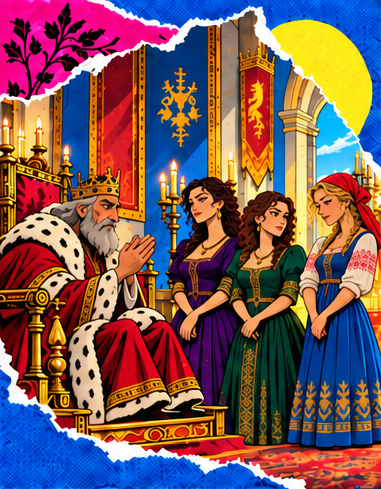
The King’s Question
Once, in a kingdom of splendid halls and richly embroidered banners, a king called his three daughters before his throne. Age had made him think of the future, and he wished to know which daughter loved him most.
The elder daughters answered with fine comparisons: they loved their father more than jewels, beautiful garments and all the treasure in his palace. The youngest, Maruška, listened quietly. When her turn came, she spoke without a trace of flattery: she loved him as much as salt.
The court fell silent. The king could not understand why something so ordinary should stand beside the splendour of gold. He heard an insult where Maruška had meant the deepest affection.
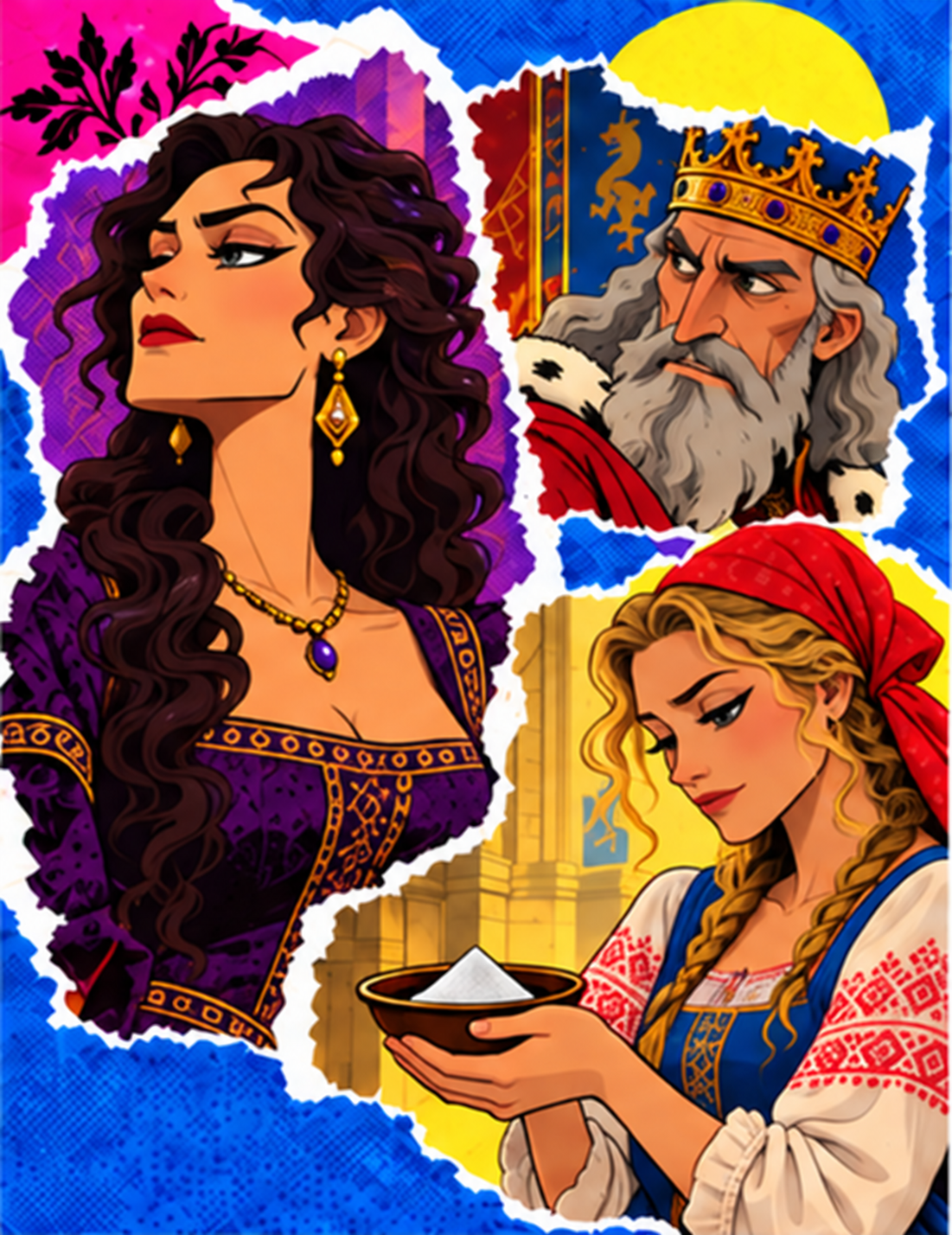
More Than Gold
Maruška did not withdraw her answer. Salt was present in the humblest meal and needed by everyone, rich or poor. She knew that its worth was not measured by its sparkle.
But the king thought she had disgraced him in front of her sisters. The elder daughters looked on as his anger grew, and Maruška realised that honesty had brought her into danger.
In some tellings, the question concerns the daughters’ love; in others, the future of the kingdom. In each, her comparison exposes a gap between outward wealth and what people truly need.
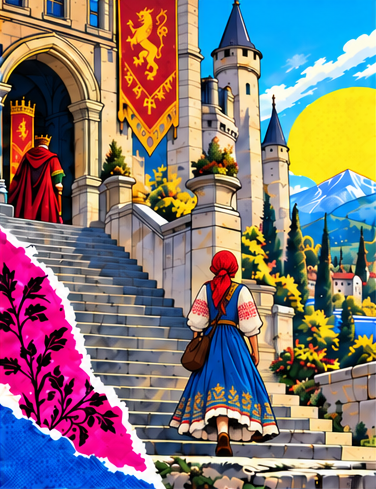
Beyond the Palace
The king ordered his youngest daughter to leave. She took a few belongings, wrapped a scarf over her hair and stepped away from the palace where she had spent her childhood.
Beyond the gates, the road led past fields and hills into unfamiliar country. She was frightened, but did not regret loving her father as she had said. What she lacked in possessions, she carried in patience and courage.
While her sisters remained among the palace treasures, Maruška began to discover the value of ordinary work and the kindness of strangers.
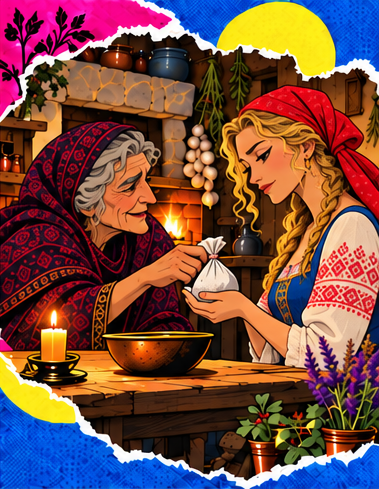
The Old Woman’s Gift
After wandering through the countryside, Maruška came upon an elderly woman who invited her into a modest cottage. The fire was warm, herbs hung from the beams and a simple meal waited on the table.
The old woman offered the princess shelter and taught her to help with everyday tasks. Maruška learned without complaint. She did not know that her host understood more about the kingdom’s coming trouble than she revealed.
In Eslaby’s illustrated retelling, the woman places a small pouch of salt in Maruška’s hands. It is an ordinary-looking gift with extraordinary significance, given when the young woman needs hope.
The Feast Without Flavour
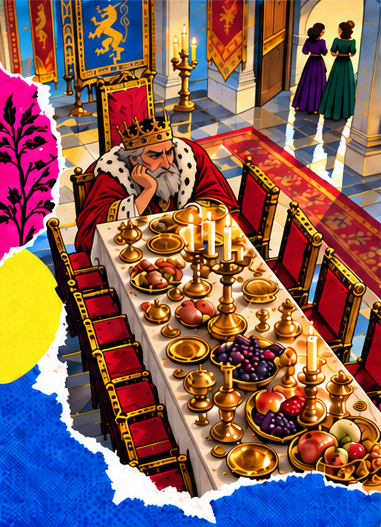
Back at the palace, the king continued to surround himself with gold, beautiful tableware and feasts. Then salt began to disappear from the kingdom. The royal cooks could prepare rich dishes, but could no longer season them.
One banquet after another fell flat. Even the king, seated before golden goblets and abundant food, found little pleasure in eating. His riches were powerless to replace a pinch of the missing mineral.
As the trouble spread, the words of the banished princess returned to him. Perhaps Maruška had not belittled him. Perhaps she had understood something he had never considered.
A Pinch of Truth
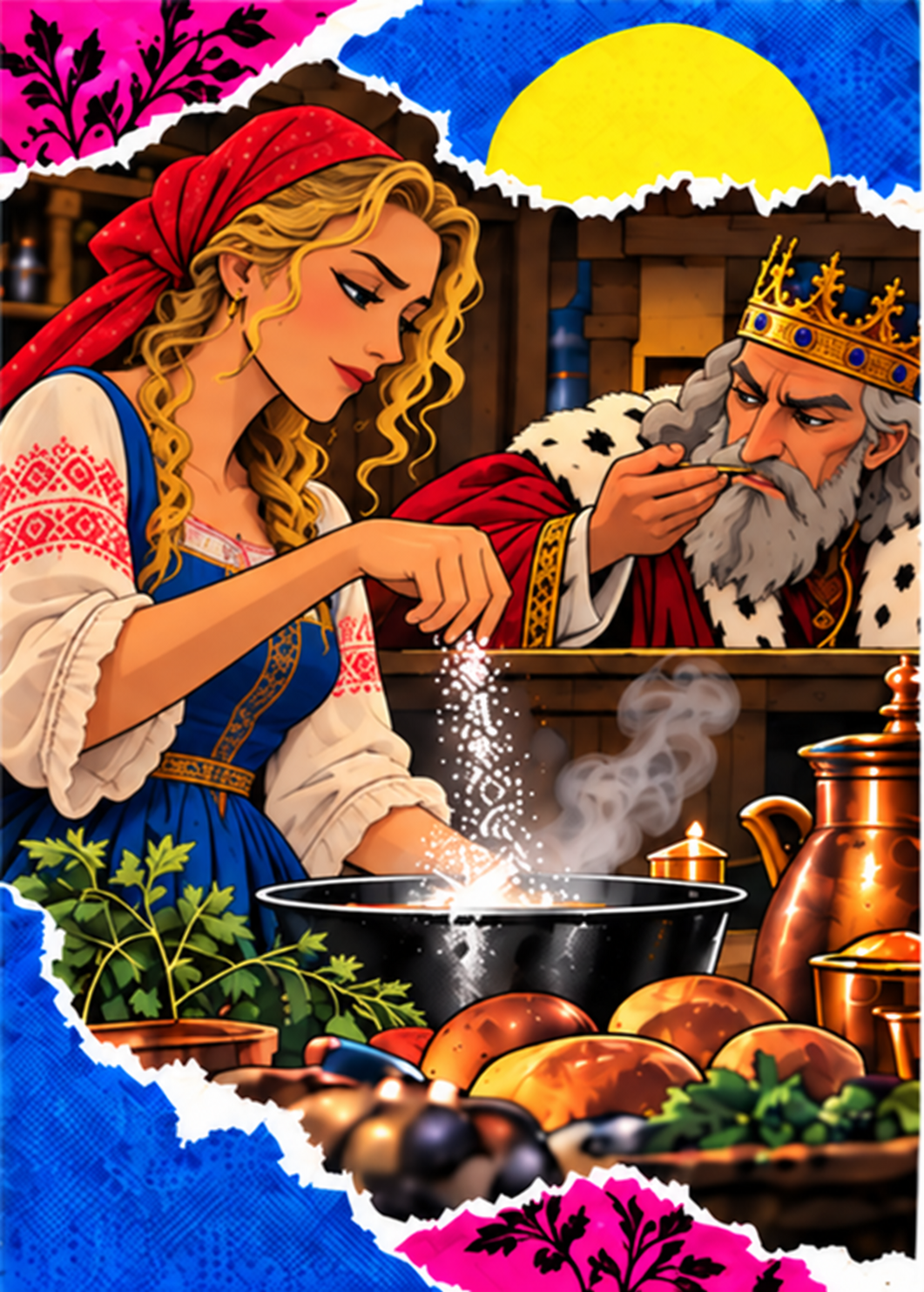
Maruška eventually returned to her father’s home, carrying the gift of salt. She approached the royal kitchen and quietly added a little to the food. At last the king tasted a meal with flavour again.
The change was simple but unmistakable. What countless jewels could not do, a small handful of salt had accomplished. In the illustrated scene, Maruška sprinkles the precious grains as her father tastes the dish.
The king recognised his daughter and began to grasp her meaning: she had loved him as much as something essential, constant and easily overlooked.
The King’s Apology
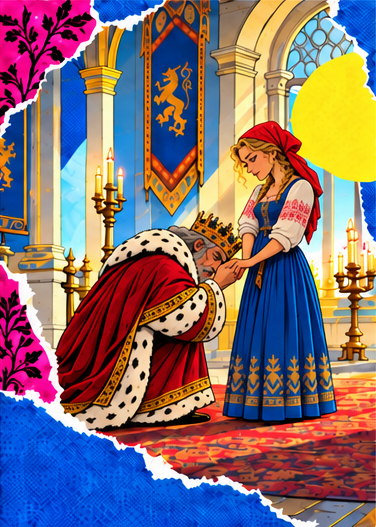
There was no proud speech left for the king to make. He approached Maruška and asked her forgiveness for mistaking sincere love for disrespect.
In the palace where he had once rejected her, the king lowered himself before his daughter. She did not demand riches or revenge. Their reconciliation began with a simple act of understanding.
This seventh illustration focuses on that apology, a deeply human moment in a tale otherwise filled with royal halls and fairy-tale wonders.

The True Treasure
At last father and daughter embraced. The kingdom had learned that gold could decorate a table, but could not make its food nourishing or its people happy.
The traditional story continues in some versions with a magical source of salt and Maruška’s future as a wise ruler. Eslaby’s final illustration instead closes on the personal heart of the legend: the bond restored between a father and his daughter.
Soľ nad zlato does not ask us to reject beauty or treasure. It reminds us to recognise the things that sustain life and love, even when they appear unremarkable.
What Is the Meaning of “Salt More Precious Than Gold”?
The message is not that gold is useless. Gold has beauty and exchange value, but salt represents something basic and indispensable. The king makes the mistake of confusing the splendour of a comparison with the depth of the feeling behind it.
Maruška’s answer is thoughtful rather than flattering. She loves her father as much as an essential part of life. When salt vanishes from the kingdom, the king learns that what people take for granted can become priceless in its absence.
The story also rewards humility and useful work. Away from the palace, Maruška learns practical skills from the wise woman. She returns not to demand revenge but to share what everyone needs. The tale ultimately presents leadership as care for others rather than possession of riches.
Salt also has a long-standing place in European food and hospitality. In the story, salted bread becomes the simple gift through which reconciliation takes place. The symbolism is effective precisely because the object is so ordinary.
From Oral Tradition to Books, Art and Performances
Folk tales develop through retelling, and Soľ nad zlato exists in different literary, theatrical and illustrated forms. The version used for this article includes the wise woman, the disappearing salt, the gift of a never-empty pouch and the extraordinary underground realm of salt crystals. Shorter modern summaries sometimes leave out the underground episode.
The eight Eslaby illustrations are a modern artistic interpretation and close with the king and Maruška’s reunion. The traditional long-form narrative includes additional magical events that cannot all be shown within eight illustrations.
The story also has a visual heritage. The Slovak National Gallery documents an illustration by Emil Makovický dated 1956, made for a book illustration series associated with the fairy tale. This is an example of how Slovak artists have reimagined the story across generations.
Its relevance is not confined to the page: Slovak theatre companies continue to adapt it for families. For example, Divadlo ŠiBe presents a stage production inspired by Dobšinský’s story.
For readers exploring more Slovak folklore, visit Eslaby’s Janko Hraško collection, another illustrated tale about a hero whose value cannot be judged by appearances.
Frequently Asked Questions
What does Soľ nad zlato mean in English?
It means “Salt More Precious Than Gold” or, more literally, “Salt Above Gold”. The title expresses the value of an ordinary but essential resource.
Who is Maruška in the fairy tale?
Maruška is the king’s youngest daughter. She says she loves her father as much as salt, and her honesty is initially misunderstood.
Who wrote Soľ nad zlato?
The story has roots in oral tradition. It was preserved in written form through collectors and writers including Pavol Dobšinský; the recorded version also mentions a telling heard by Božena Němcová in Sliač.
Why does the king banish his daughter?
He considers salt too common to represent deep love. His anger comes from misunderstanding her comparison.
What happens when the kingdom loses salt?
Food loses its flavour, everyday life suffers and the king begins to understand the necessity that Maruška recognised from the beginning.
How does Soľ nad zlato end?
Maruška returns with salt, reconciles with her father and is recognised as his successor. In the recorded version she also discovers a miraculous underground salt realm.
Is this article a translation of Dobšinský’s text?
No. It is a new English retelling of the traditional episodes, written for Eslaby Journal, with links to historical versions for those who want to read the source material.
Sources & Further Reading
- Zlatý fond SME — Soľ nad zlato. Digitised historical text in Dobšinský’s third volume.
- Ľudo Slovenský — Soľ nad zlato. Readable presentation of the full text, with explanations of older Slovak terms.
- Slovak National Gallery — Emil Makovický, Soľ nad zlato (1956). Historic illustrated artwork in a public collection.
- Municipal Library Piešťany — Soľ nad zlato. Library catalogue documenting a modern Slovak publication.
- Divadlo ŠiBe — Soľ nad zlato. Contemporary theatrical adaptation.
