Brutalist Architecture in Bratislava: A Guide to the City’s Boldest Buildings
Discover the inverted pyramid, Hotel Kyjev, the UFO Bridge and the remarkable post-war buildings that changed Slovakia’s capital.
Bratislava is known for its castle, pastel-coloured Old Town and views across the Danube. Yet a different city reveals itself just a few streets away: a city of concrete, steel, striking silhouettes and ambitious architectural experiments.
From an upside-down pyramid housing a national broadcaster to a hotel tower rising above a busy central square, Bratislava’s post-war architecture tells a fascinating story about design, politics and changing attitudes to heritage.
This guide explores its most memorable landmarks, explains why the word Brutalism does not describe every socialist-era building, and offers a practical walking route for discovering them.
What Is Brutalism — and Why Does Bratislava Have So Much Bold Architecture?
Brutalism is an architectural approach often associated with exposed materials, monumental forms and structural honesty. The name comes from the French béton brut, meaning raw concrete.
But Bratislava’s post-war landmarks are more varied than one label suggests. Some buildings fit common definitions of Brutalism; others are better understood as late modernism, structural expressionism or post-war socialist-era architecture. The inverted steel pyramid of Slovak Radio, for example, is far more than a simple concrete block.
During the 1960s and 1970s, architects in Czechoslovakia explored expressive forms and new construction methods. Public buildings, hotels, transport infrastructure and cultural institutions became places to experiment with scale, geometry and materials. Political conditions shaped what could be built, but the results cannot be reduced to a single political or artistic style.
Slovak Radio Building: The Inverted Pyramid
At Mýtna Street, one of Bratislava’s strangest and most recognisable structures appears to balance against gravity: the Slovak Radio Building, often nicknamed the inverted pyramid.
Its sharply angled steel structure creates an almost impossible visual impression: the upper levels spread wider than the base. Inside, the building includes specialist broadcasting facilities and a concert hall. The innovative design was controversial for decades, yet it is now recognised as an important work of Slovak late modernism. It was declared a national cultural monument in 2018.
Approach the building from more than one side. Its silhouette changes with your viewpoint, and close-up details reveal how much of its effect comes from structural lines rather than decorative surface treatment.
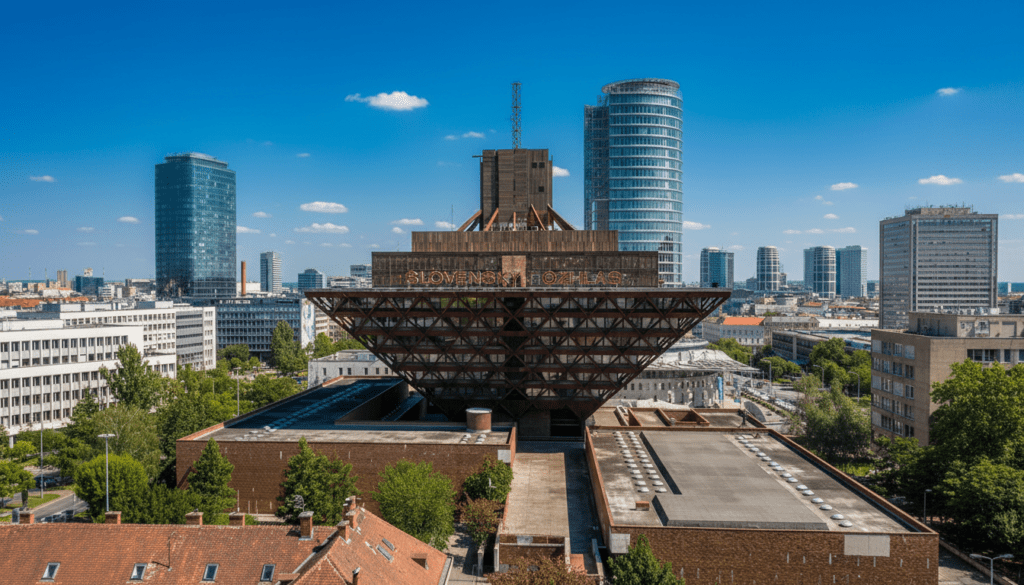
The inverted pyramid, reimagined
Its dramatic silhouette also makes this building a natural subject for graphic art. Explore the Eslaby interpretation in striking monochrome or a more futuristic palette.
View monochrome metal artFor a deeper architectural record, read the Register of Modern Architecture’s building profile. The official visitor guide explains how to see the exterior and attend events in the hall.
Hotel Kyjev and Prior: Monumental Geometry at Kamenné Námestie
A short walk from Bratislava’s historic centre leads to Kamenné námestie, where a triangular department store and a tall hotel were conceived as an ambitious modern urban complex.
Architect Ivan Matušík designed the Prior department store and Hotel Kyjev as related parts of a larger development. Prior was completed in 1968, followed by the hotel in 1973. Their contrasting shapes — a lower, angular retail volume and the repetitive vertical rhythm of a hotel tower — make the complex an important example of the city’s post-war transformation.
The buildings are not identical in material or purpose, and their design is more sophisticated than the stereotype of unadorned grey concrete. The complex is known for its use of Spiš travertine cladding, modern commercial features and the strong relationship between separate building masses.
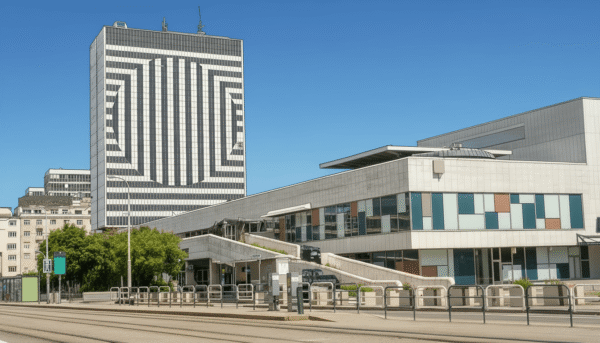
Hotel Kyjev in black and white
Its repeated windows, imposing façade and sense of rhythm are especially effective in a monochrome composition — a visual reminder that everyday buildings can become powerful design subjects.
Explore Hotel Kyjev metal artToday the complex remains a subject of architectural interest and debate. Its importance is not merely nostalgic: it raises questions about how cities can maintain, reuse and interpret twentieth-century buildings without erasing their identity.
For architects, dates and project context, consult the architectural register entry for Prior and Hotel Kyjev.
Most SNP and the UFO: Engineering as a City Landmark
Few structures transform Bratislava’s skyline as dramatically as the bridge crossing the Danube beside the castle, crowned by a disc-shaped observation structure popularly known as the UFO.
The SNP Bridge is a remarkable piece of transport infrastructure and late-modernist engineering. Its inclined pylon supports the bridge deck with cables, and the UFO-shaped structure adds a futuristic form to the city skyline. The bridge opened in the early 1970s and became one of Bratislava’s most recognisable symbols.
The bridge also has a more difficult urban history. Construction was connected to major changes around the river crossing, including the loss of historic urban fabric near the castle. Appreciating its engineering achievement does not require ignoring the destruction and disruption associated with the project.
What to notice
The asymmetrical structure, the sloping pylon, the cables and the contrast between the disc-shaped restaurant and the surrounding historic skyline.
Where to read more
The Register of Modern Architecture explains the bridge’s design and urban-planning context.
Slovak National Gallery: The Controversial Bridge Extension
On the Danube embankment, the Slovak National Gallery (SNG) brings a different version of post-war architectural experimentation into view. Architect Vladimír Dedeček designed an elevated extension commonly called the Bridge, connecting and expanding the gallery complex with a bold horizontal gesture.
The building long divided public opinion. For some it interrupted a historic setting; for others it represented a confident, original architectural idea. The extension opened in 1977, later suffered serious technical problems, and became part of a major reconstruction completed in 2022.
Its story is especially revealing because it demonstrates how difficult the preservation of modern architecture can be. Reuse requires more than simply protecting a façade: the building must also function for visitors, collections and contemporary cultural life.
Other Modernist Landmarks Worth Noticing
Freedom Square (Námestie slobody)
Look at the scale and spatial organisation of this central civic area, including its landmark fountain and relationship with surrounding institutional buildings. It reveals the ambition of twentieth-century urban planning in Bratislava.
Kamzík Television Tower
Above the city, the television tower forms a striking technical silhouette against the forested hills. Although it is not a textbook Brutalist building, it belongs to Bratislava’s broader modern architectural identity. Explore Eslaby’s monochrome Kamzík print.
For a broader selection, Visit Bratislava’s guide to iconic buildings also covers lesser-known examples and provides useful historical context.
Istropolis: Remembering a Demolished Modernist Landmark
At Trnavské mýto, the former Trade Union House — widely known as Istropolis — once made a powerful statement about civic culture. The complex hosted performances and public gatherings, and its angular forms helped define the junction’s character.
Its demolition began in 2022, after years of debate about the future of Bratislava’s twentieth-century heritage. Unlike a preserved monument that visitors can still explore, Istropolis now survives through photographs, documents, memories and artistic reconstructions. This distinction matters: the Eslaby illustrations below depict the former building, not the site as it appears today.
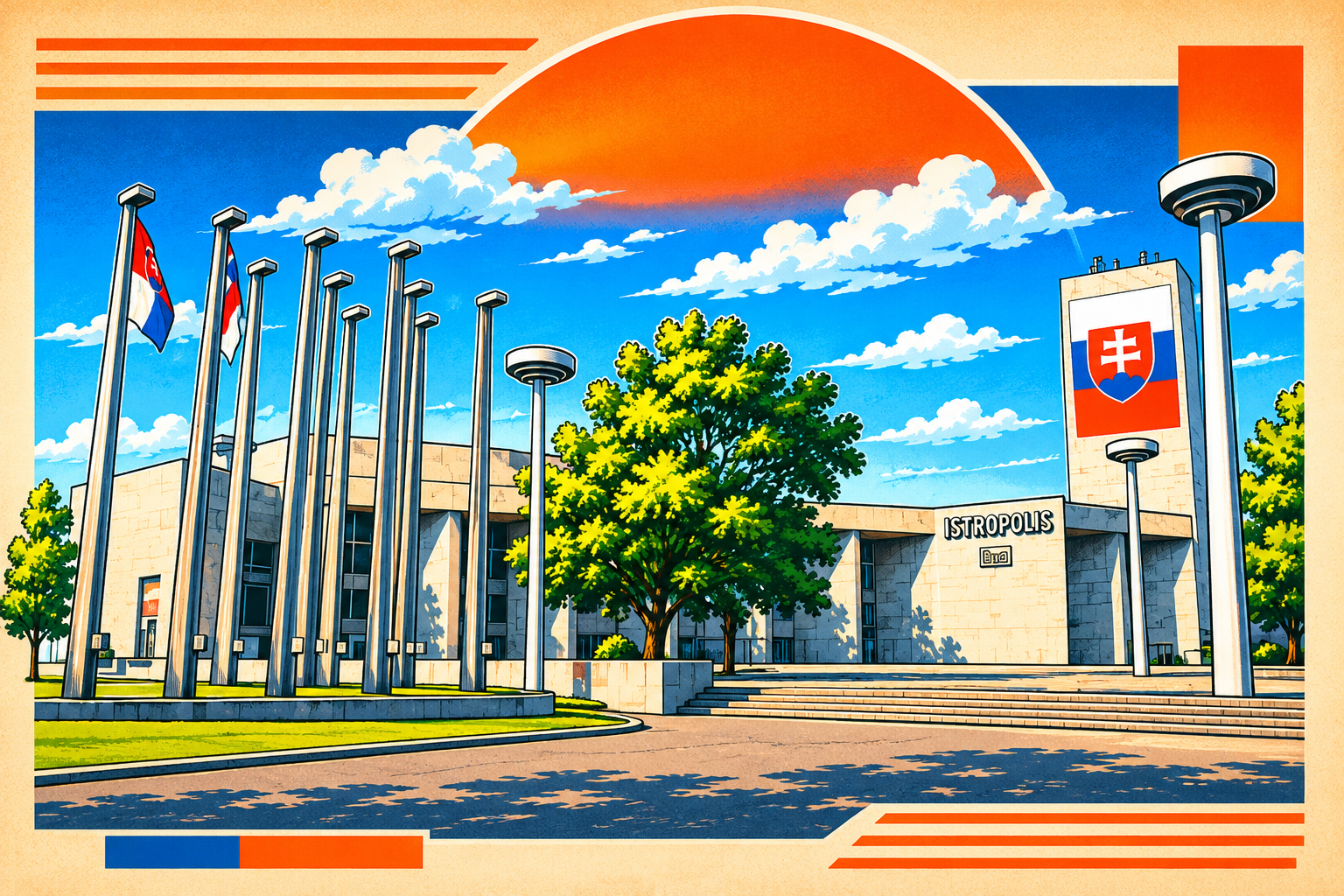
Istropolis: Colour and Memory
A bright architectural illustration that retains the building’s monumental entrance and civic symbolism.
Explore this metal print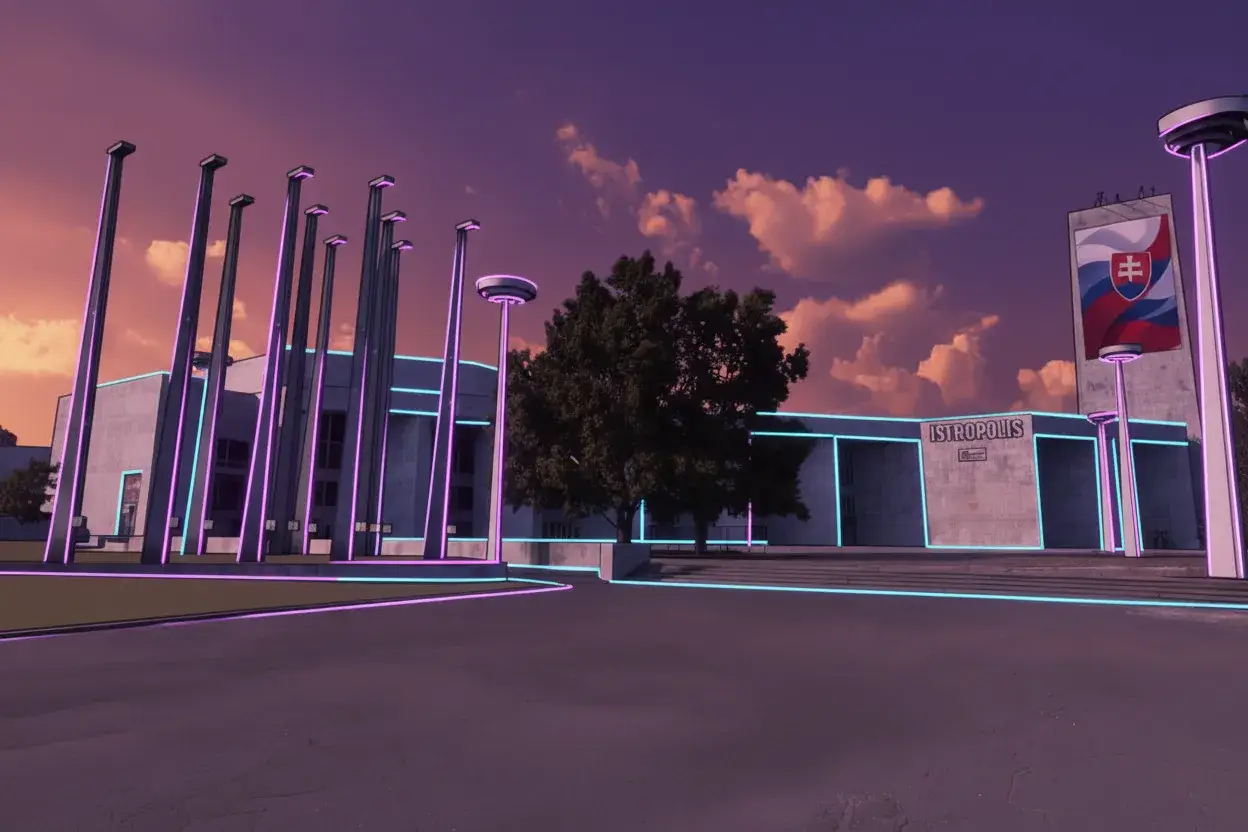
The Lost Future of Istropolis
The same architectural landmark imagined in a neon-lit alternative city.
Explore the cyberpunk artworkThe images are original Eslaby artwork, not documentary photographs of the demolished structure. Read more about the debate surrounding its loss at Visit Bratislava’s Brutálna Bratislava programme.
Tržnica at Trnavské Mýto: Modernism in Everyday Life
Modernist architecture is not limited to extraordinary monuments. Bratislava’s New Market Hall, commonly called Tržnica, shows how a large building for everyday shopping can shape the identity of an entire neighbourhood.
With its expansive glazed elevations and recognisable roofline, the market hall presents a very different architectural language from the monumental Istropolis that once stood nearby. They belong to the same wider era of experimentation with public space, but that does not make them identical examples of Brutalism.
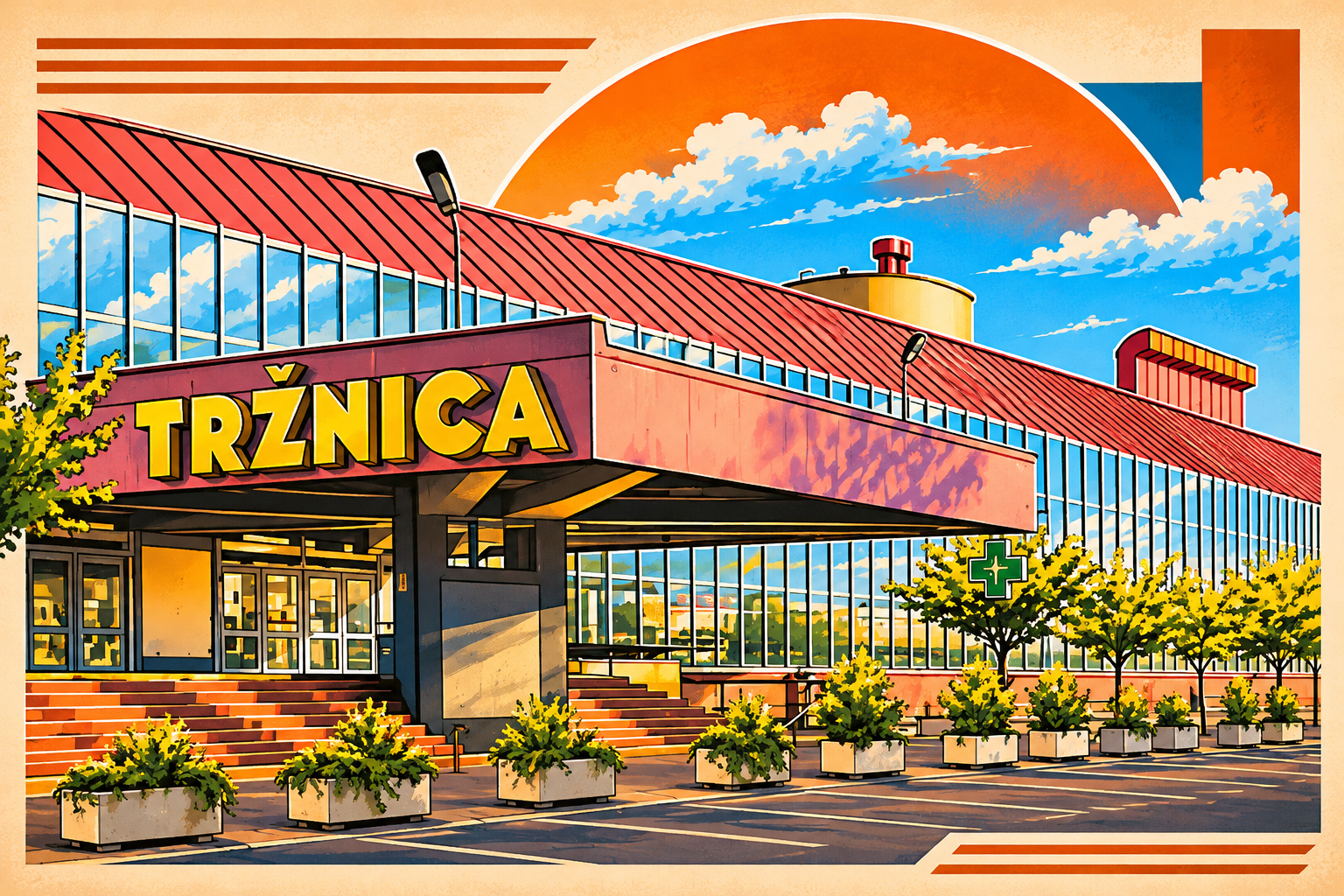
Tržnica: The Everyday Landmark
A colourful illustration of a familiar meeting place and distinctive commercial structure.
See the Tržnica print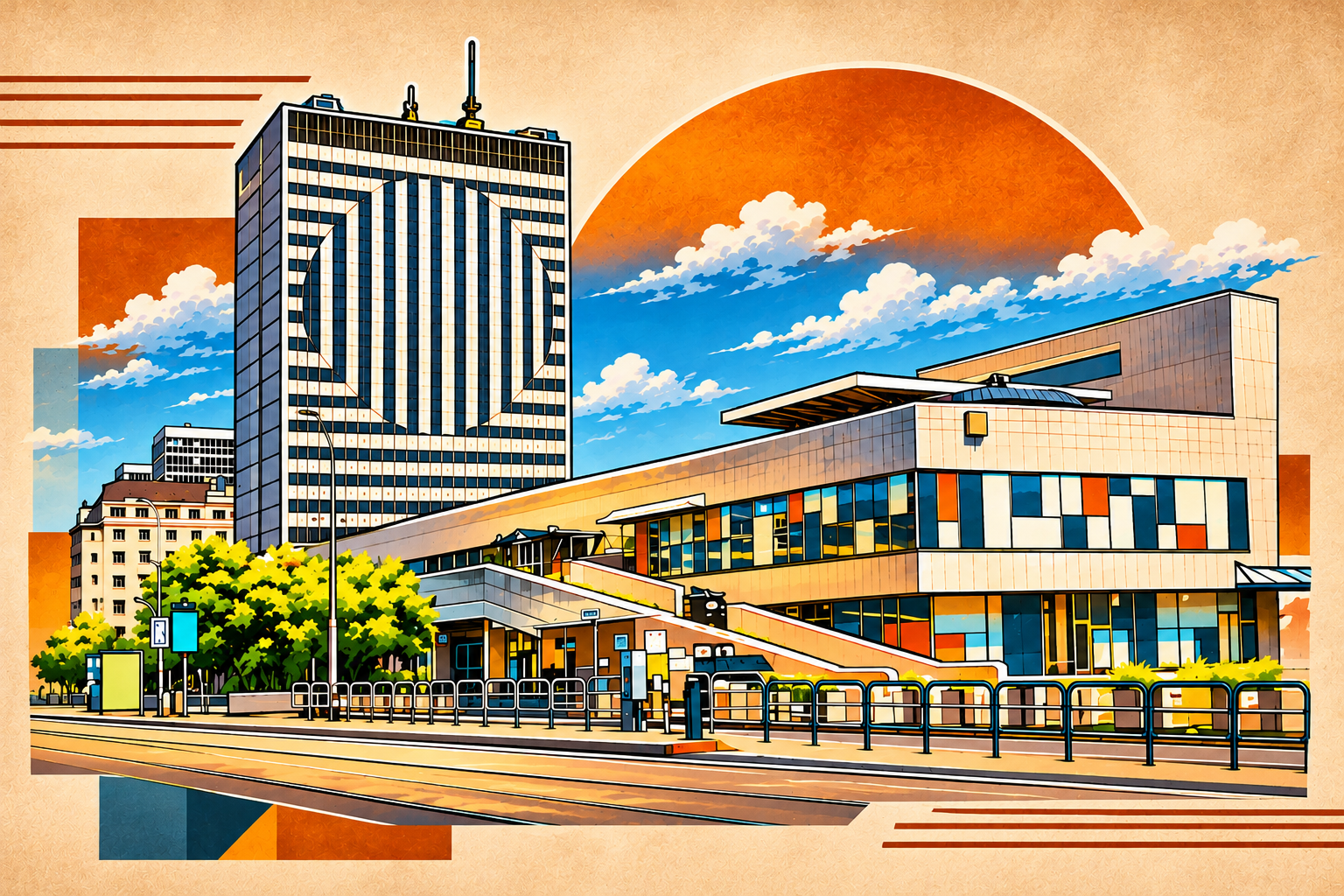
Hotel Kyjev and Prior
The landmark hotel and department-store setting revisited in a warmer, poster-inspired palette.
See the Hotel Kyjev printFreedom Square, the Družba Fountain and the Modernist City
Námestie slobody, or Freedom Square, helps explain how post-war designers imagined open civic spaces. At its centre, the sculptural Družba Fountain uses a metallic flower form surrounded by geometric basins.
The fountain and the surrounding buildings belong to Bratislava’s modernist urban history. Their appeal lies in the relationship between sculpture, architecture, water and public movement — not simply in their use of concrete. For readers who want the broader context, the city’s architecture guide provides further reading.
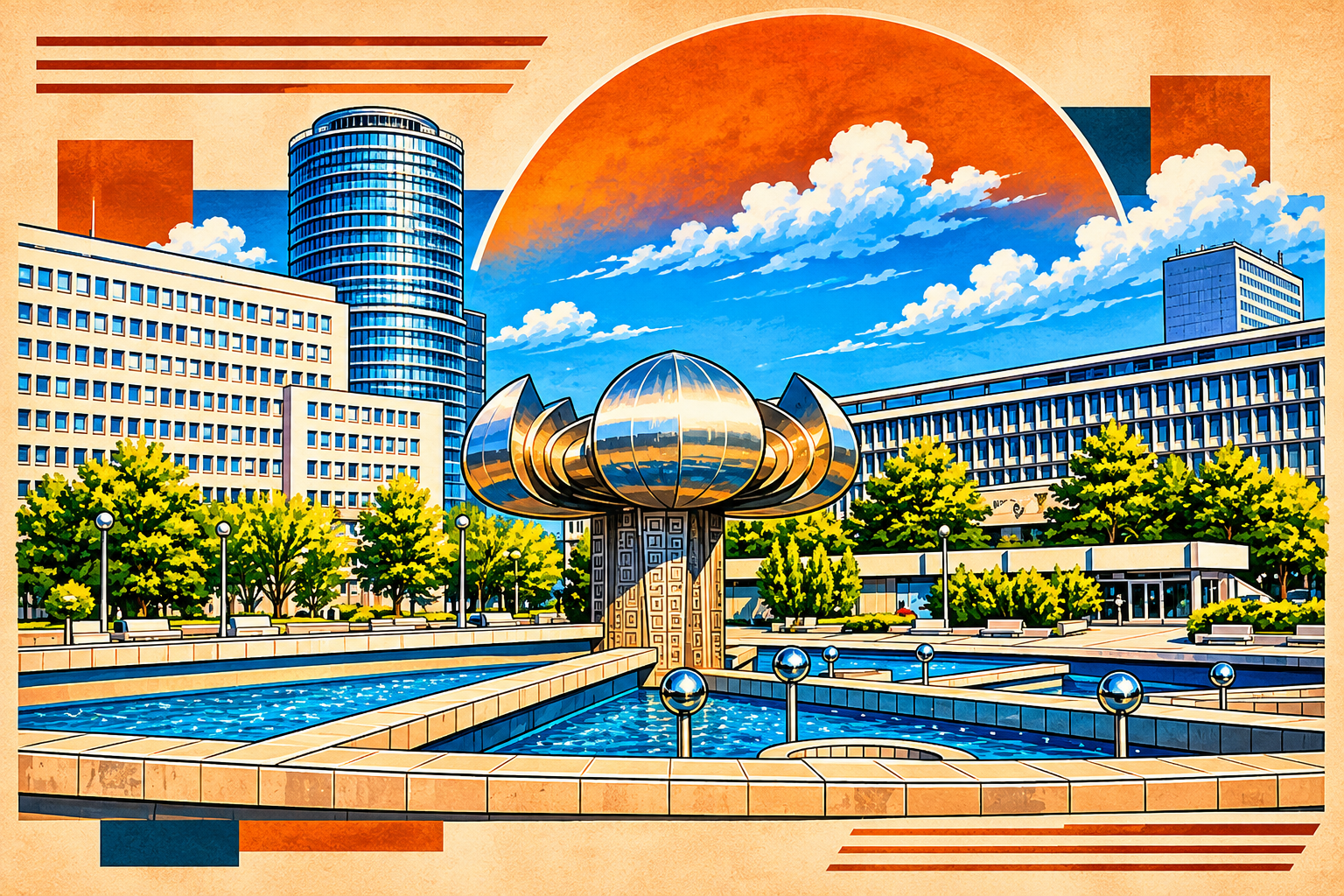
The Fountain and the Square
Geometric water basins and the sculptural centrepiece presented in vivid retro colours.
Explore the fountain artwork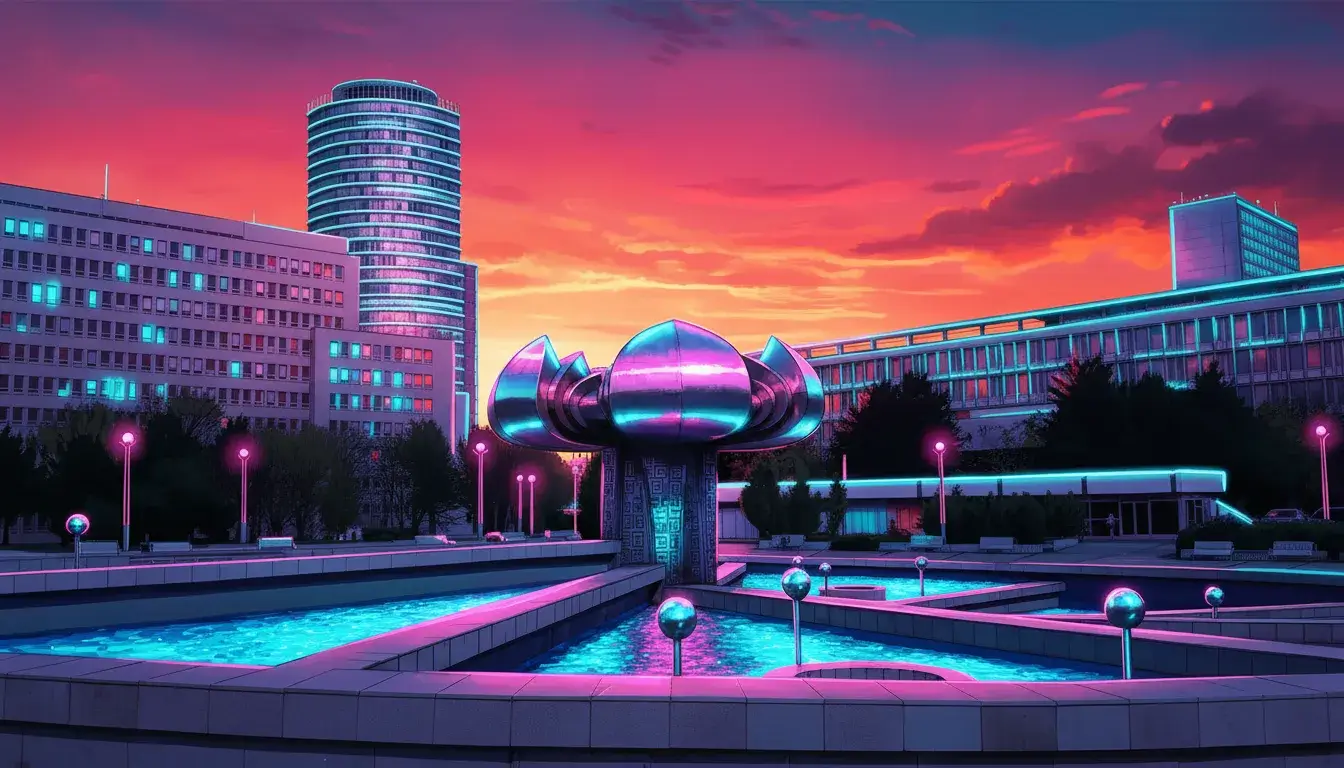
The Fountain of Light
A science-fiction treatment of one of Bratislava’s most recognisable modern public artworks.
Explore the cyberpunk versionFrom the Radio Pyramid to Petržalka: A Broader Modernist Skyline
Bratislava’s twentieth-century identity reaches beyond individual showpieces. The UFO, Kamzík television tower, large housing estates and public memorials all contribute to the city’s distinctive urban landscape.
Here are further Eslaby illustrations that connect the article’s architectural story with the wider city. Some show Brutalist-associated landmarks; others represent late modernism, engineering, commemorative design or mass housing. They should not all be labelled Brutalist.
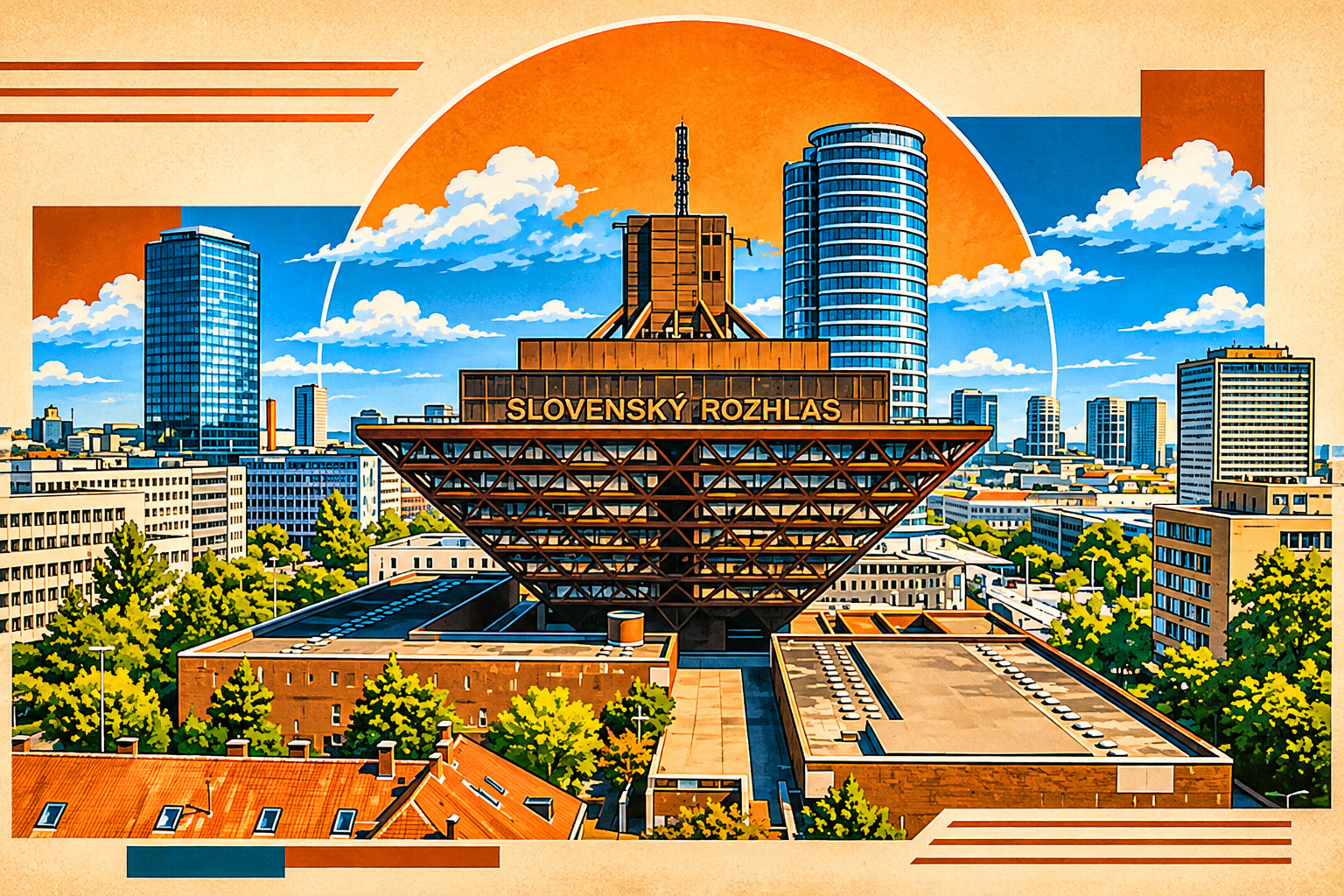
The Inverted Pyramid in Colour
The structural geometry of Slovak Radio, seen through a vivid vintage-inspired palette.
Explore the Radio print
Most SNP and UFO Tower
A striking combination of bridge engineering, modernist design and the Danube skyline.
See the skyline artwork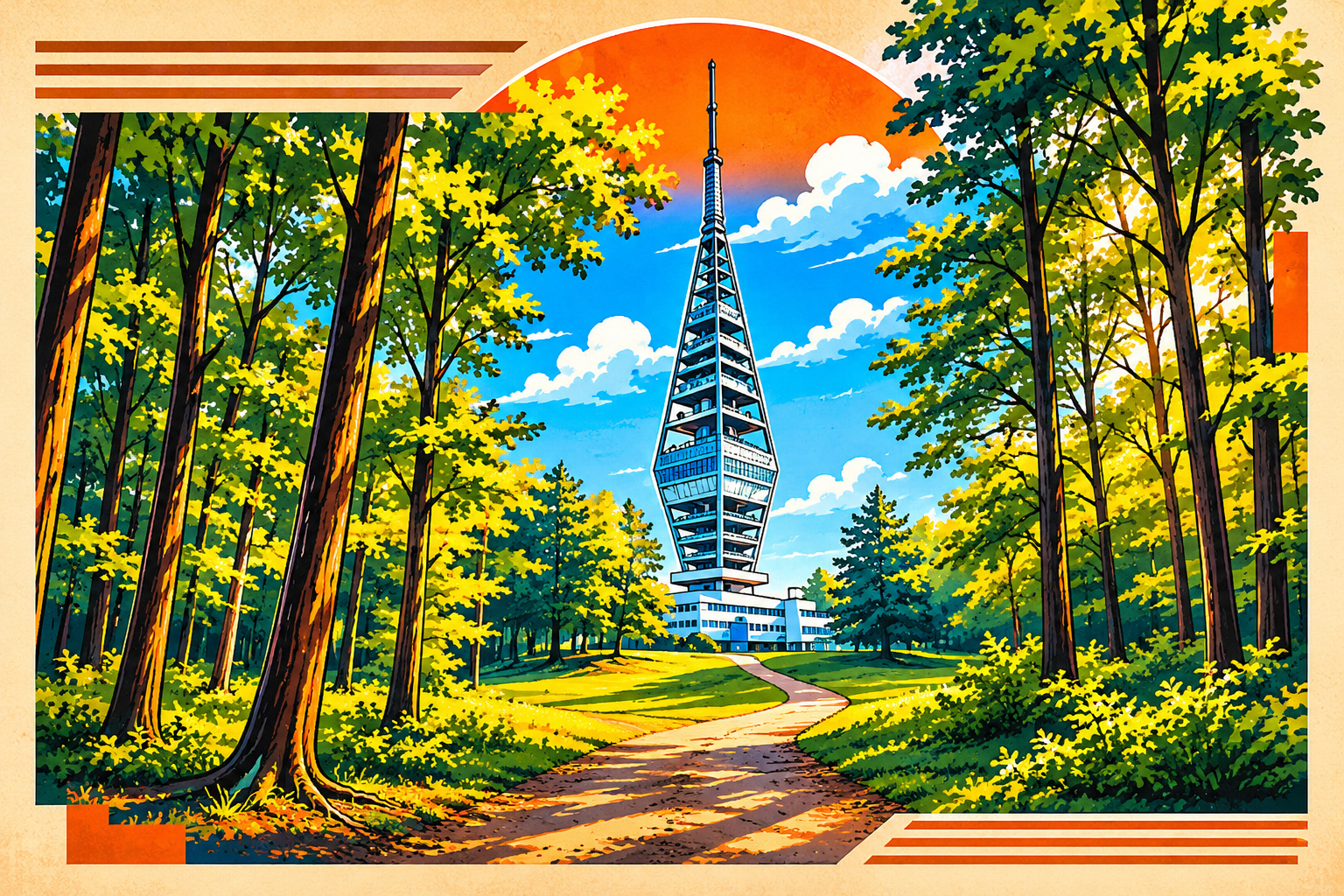
Kamzík Television Tower
A technical landmark set amid the wooded hills north of the city.
Explore Kamzík artwork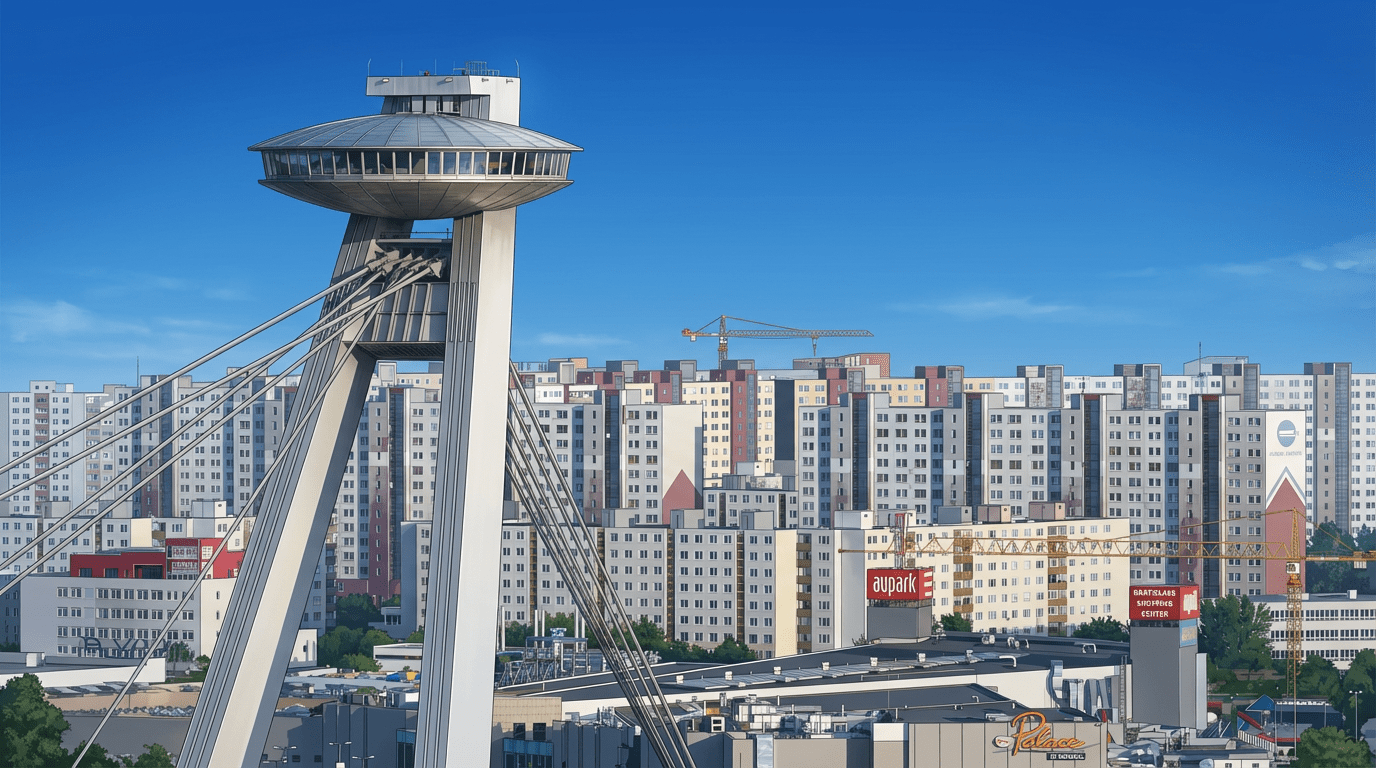
Petržalka: The Residential Skyline
The huge residential district is essential to understanding Bratislava’s late twentieth-century growth.
Explore Petržalka art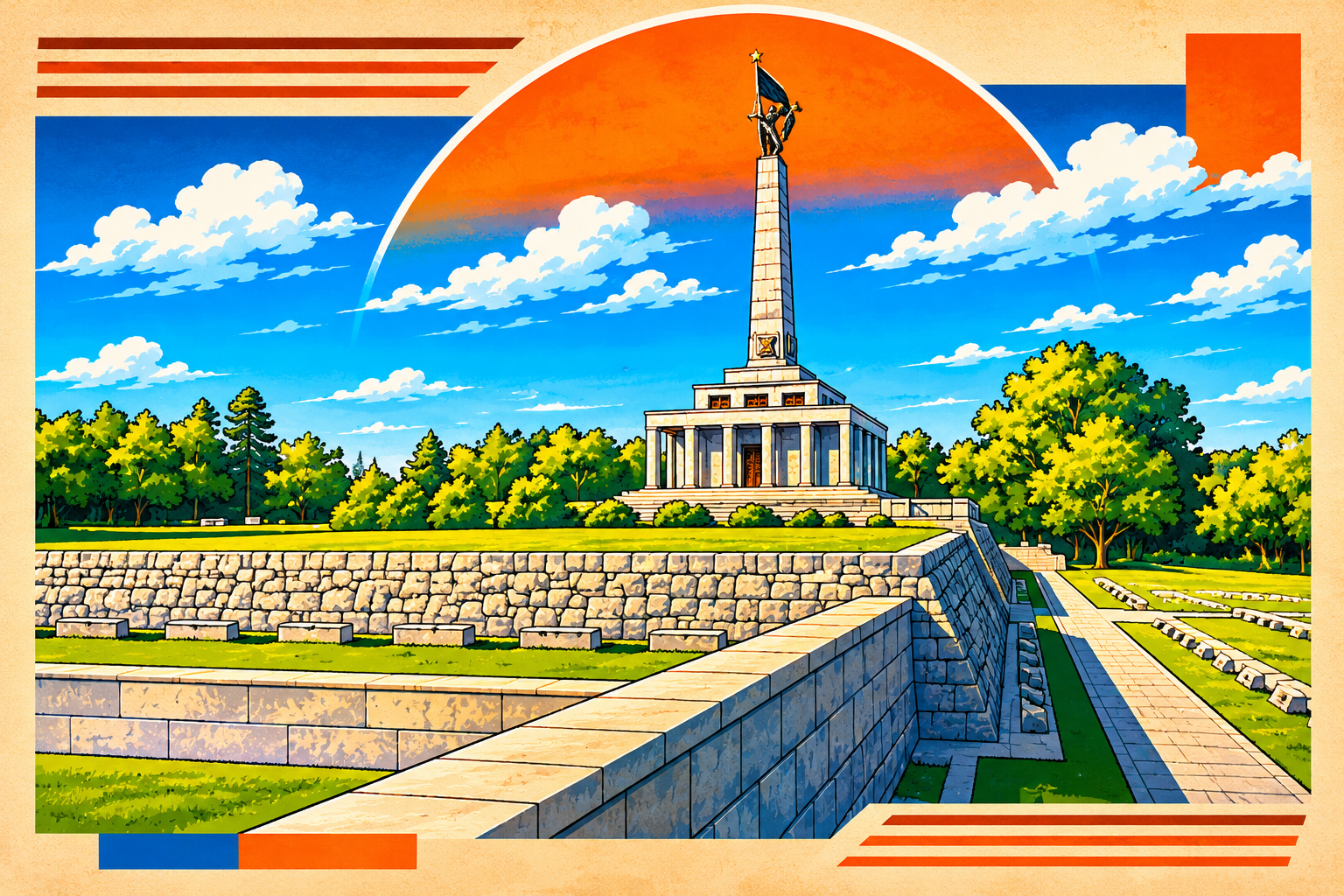
Slavín Memorial
A commemorative monument rather than a standard Brutalist building, but part of the city’s monumental skyline.
See Slavín artworkBrowse the full Bratislava metal art collection to see more styles and landmarks.
A Self-Guided Bratislava Modernist Architecture Walk
If you want to explore several landmarks in one outing, this is a practical sequence through the centre. It is a suggested order, not a timed or access-guaranteed tour.
- Slovak Radio Building, Mýtna Street. Start with the inverted pyramid, and circle the site to study the steel geometry from several angles.
- Freedom Square. Walk through a large civic space that helps explain the planning ambitions of the period.
- Hotel Kyjev and Prior, Kamenné námestie. Compare the tower and triangular department-store mass, and look for differences in surface texture.
- Slovak National Gallery, Danube embankment. See how Dedeček’s raised extension relates to older neighbouring buildings.
- Most SNP / UFO. End with the bridge, the pylon and the changing skyline of the riverfront.
Bring comfortable shoes and allow extra time for photography. Public access to interiors, exhibitions and viewpoints varies; check official visitor information before travelling. Avoid entering closed or restricted buildings.
From Controversial Concrete to Cultural Heritage
Buildings that once represented progress can later seem unfashionable, awkward or difficult to maintain. Bratislava’s late-modernist architecture has experienced precisely this shift in public perception.
There are real reasons for disagreement. Some projects displaced older streets; others present costly technical challenges. Yet judging them only by age, political association or surface appearance would overlook the skills of their designers and the lived memories attached to them.
Recognition and careful adaptation can help cities preserve a richer architectural record. The Slovak Radio Building’s monument status and the Slovak National Gallery’s reconstruction show two different ways of engaging with that legacy.
At Eslaby, this fascination with the overlooked urban landscape is part of our creative starting point. We turn architectural forms into city-inspired metal artwork — not as replacements for the real buildings, but as small reminders of why they deserve a second look.
Frequently Asked Questions
What is the most famous Brutalist-style building in Bratislava?
The Slovak Radio Building is arguably the most recognisable of Bratislava’s bold post-war landmarks. Its inverted steel pyramid is commonly discussed alongside Brutalism, though it is also described as expressive late-modernist architecture.
Who designed Hotel Kyjev in Bratislava?
Architect Ivan Matušík designed the Hotel Kyjev and Prior complex at Kamenné námestie. The department store was completed in 1968 and the hotel in 1973.
Can you visit the Slovak Radio Building?
Its exterior is visible from public areas. The building remains an active broadcasting venue; interior access is associated with concerts and scheduled events rather than general unrestricted sightseeing.
Is the UFO Bridge an example of Brutalism?
It is more precisely described as a striking post-war modernist engineering project. It is often included in architectural guides about the same period, but not every late-modernist building is Brutalist.
Where should I start an architecture walk in Bratislava?
The Slovak Radio Building and Hotel Kyjev are excellent starting points. A route connecting them with the Slovak National Gallery and Most SNP gives a varied overview of the city’s post-war design.
Sources & Architectural References
These sources document the buildings and their wider context. They are included for readers who want to explore architectural history beyond this introduction.
- Register of Modern Architecture in Slovakia — Slovak Radio Building
- Register of Modern Architecture — Prior & Hotel Kyjev
- Register of Modern Architecture — The SNP Bridge
- Visit Bratislava — Iconic Buildings of Bratislava
- Slovak National Gallery — Institutional and Architectural History
- Slovak National Gallery — Reconstruction
Editorial note: Artwork images are stylised Eslaby interpretations, not archival photographs. Product links lead to Eslaby; external references are provided for architectural research. Building access, opening arrangements and commercial availability may change.
