Krakow’s Most Iconic Architectural Landmarks
Discover the buildings, public spaces and urban symbols that define Krakow — from royal Wawel and the vast Main Market Square to Kazimierz, Kościuszko Mound and the elegant Father Bernatek Footbridge.
Krakow is one of Central Europe’s most architecturally rewarding cities. Its identity is shaped by royal hilltop silhouettes, Gothic towers, Renaissance arcades, Jewish heritage streets, fortified gates and contemporary river crossings. The Historic Centre of Krakow is part of the UNESCO World Heritage List, while districts such as Kazimierz and Podgórze add layers of urban life beyond the postcard core. This guide highlights the places that best express Krakow’s character — and pairs them with a broader visual selection from Eslaby’s Krakow collection.
1. Wawel Castle and Wawel Hill
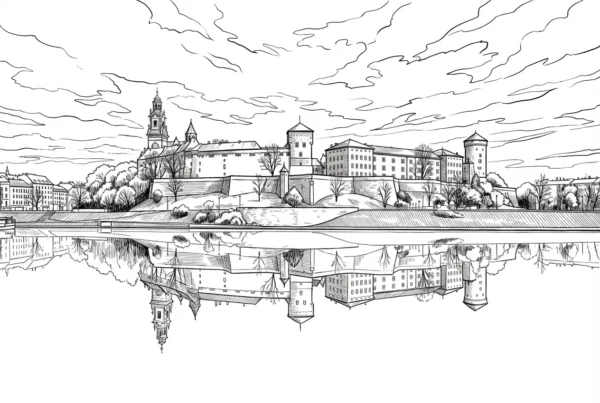
Wawel Castle — Krakow Noir · Eslaby illustration
No landmark says “Krakow” more clearly than Wawel. Rising above the Vistula River, Wawel Royal Castle and Wawel Cathedral combine medieval foundations, Renaissance rebuilding and centuries of political symbolism. It is both a royal residence and a national memory site, and its hilltop silhouette remains the city’s most recognisable panorama.
Architecturally, Wawel matters because it is not a single-style monument. Gothic remnants, Renaissance courtyards, defensive walls and cathedral towers all interact in one layered composition. For visitors, it is also one of the best places to understand how Krakow’s topography shapes its urban image: the castle becomes especially dramatic when viewed from across the river or from the boulevards below.
Explore this metal printEslaby note: Wawel appears in several different visual languages in your Krakow collection: colourful Retro Pop scenes, monochrome Steel & Stone interpretations and dragon-centred compositions that connect architecture with local folklore.
Another view of this landmark
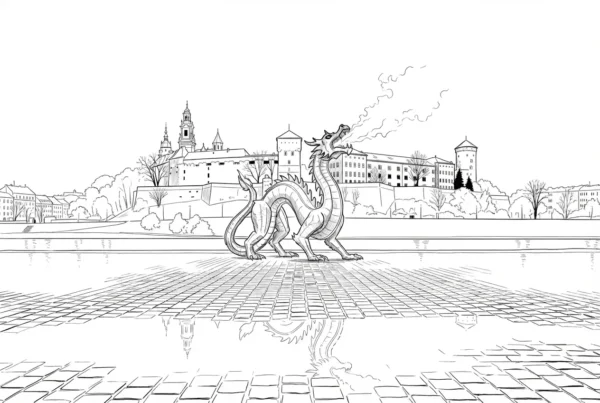 The Wawel Dragon — Krakow NoirExplore metal print
2. Rynek Główny and the Cloth Hall
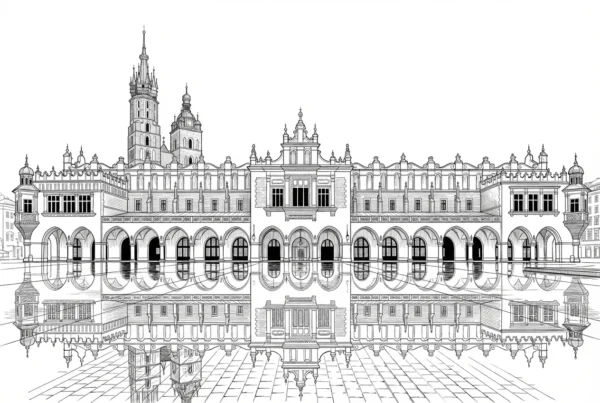
Rynek Główny and Cloth Hall — Krakow Noir · Eslaby illustration
Krakow’s Main Market Square is one of the largest medieval squares in Europe and still functions as a civic stage rather than a frozen monument. At its centre stands the Cloth Hall, or Sukiennice, whose arcaded façade and long symmetrical mass make it one of the clearest architectural symbols of the city.
The square works because of ensemble, not just isolated monuments. The Cloth Hall, surrounding townhouses, churches and monuments create a complete urban interior. This is why even a single view of the square can express so much of Krakow’s identity: trade, ceremony, tourism, memory and everyday movement all overlap here.
Explore this metal print3. St Mary’s Basilica
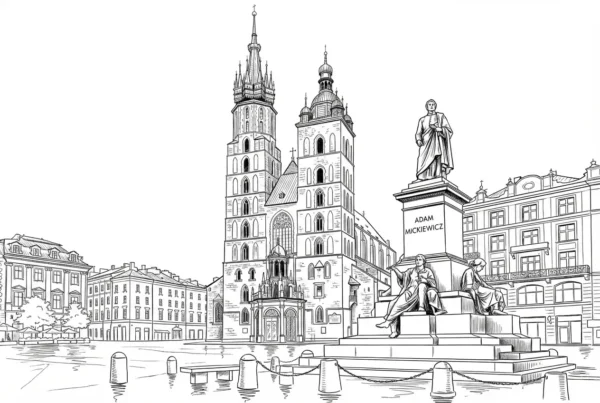
St Mary’s Basilica — Krakow Noir · Eslaby illustration
On the edge of the Main Market Square, St Mary’s Basilica introduces a more vertical and dramatic rhythm to the city centre. Its two unequal Gothic towers are among the most recognisable silhouettes in Poland. The church is famous not only for its exterior but also for the bugle call associated with one of its towers.
From an architectural point of view, St Mary’s Basilica gives Krakow a strong skyline marker. In visual terms, it pairs especially well with the Adam Mickiewicz Monument and the paving of the square, creating one of the city’s classic viewpoints — a composition that is equally effective in colourful, minimalist and noir reinterpretations.
Explore this metal print4. Barbican and St Florian’s Gate
Krakow’s fortified edge survives unusually well. The Barbican and St Florian’s Gate still communicate the city’s medieval defensive logic, even though the surrounding context has evolved. Circular brick massing, thick walls and strong geometry make the Barbican particularly photogenic and easy to read as an architectural object.
These landmarks are essential because they remind visitors that Krakow was once a protected mercantile city, not only a ceremonial royal capital. Together with fragments of the old walls, they help explain how one entered the historical city and how urban space was controlled and staged.
Explore the wider Krakow collection for other historic landmarks. We have not inserted an unrelated product image for this stop.
5. Kazimierz and Plac Nowy
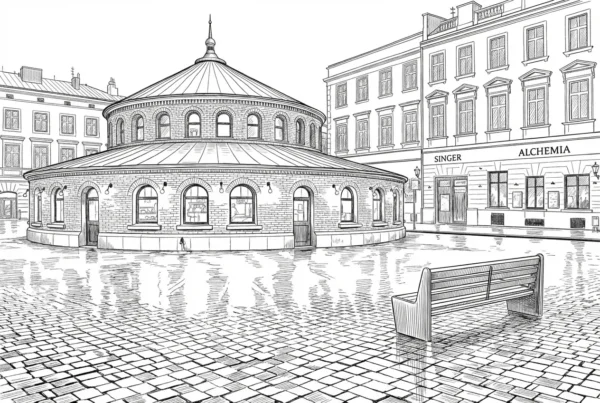
Plac Nowy — Krakow Noir · Eslaby illustration
Kazimierz introduces a different scale and mood. Rather than grand royal panoramas, it offers layered streets, intimate façades, synagogues, courtyards and the unique circular market building at Plac Nowy. That small rotunda has become one of the district’s most recognisable structures and an anchor of local life.
Architecturally, Kazimierz is not about monumental symmetry. Its value lies in texture, memory and atmosphere. Plac Nowy captures that especially well: it is modest in scale but rich in identity, making it an ideal subject for decorative city art because it feels unmistakably local and immediately recognisable to people who know the district.
Explore this metal print6. Kościuszko Mound
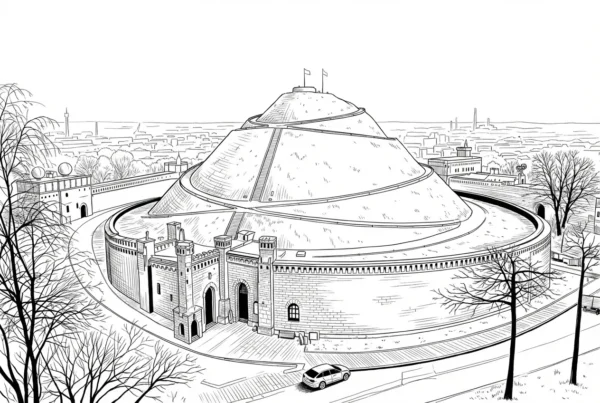
Kościuszko Mound — Krakow Noir · Eslaby illustration
Kościuszko Mound is not a conventional building, yet it is one of Krakow’s most distinctive architectural landmarks. The historic mound and its surrounding fortification create a strong geometric form above the city. Its spiralling path, elevated setting and panoramic views make it one of the best locations for understanding Krakow as a wider landscape, not just a historic centre.
Because of its silhouette, Kościuszko Mound translates especially well into graphic art. In both colour and monochrome treatments, the circular route and terraced mass create a memorable composition that feels both architectural and topographical.
Find this landmark in the Krakow collection7. Father Bernatek’s Bridge and the Vistula riverfront
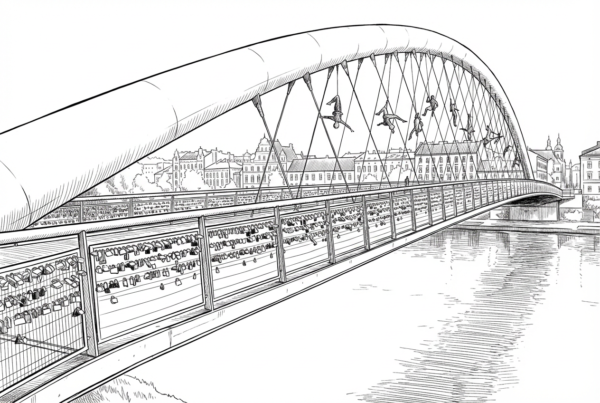
Father Bernatek’s Bridge — Krakow Noir · Eslaby illustration
Modern Krakow also deserves attention, and Father Bernatek’s Footbridge is one of the clearest examples. Linking Kazimierz and Podgórze, the bridge is known for its elegant steel arch and the acrobat sculptures suspended above the deck. It combines infrastructure, public art and scenic river views in a way that feels contemporary without breaking the city’s atmosphere.
The Vistula boulevards and bridge viewpoints are essential to the experience of Krakow because they frame the city’s monuments from a distance. Many of the classic Wawel panoramas depend on this riverside relationship. In other words, Krakow’s architecture is not just what you stand next to — it is also what you see reflected in the water.
Explore this metal printAnother view of this landmark
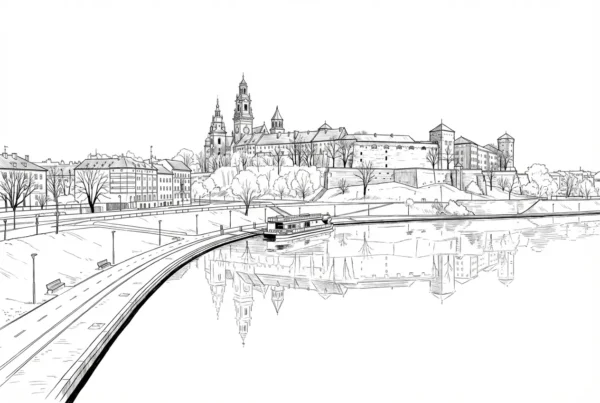 Vistulan Boulevards — Krakow NoirExplore metal print
Suggested Architectural Route
| Stop | Why it matters | What to notice |
|---|---|---|
| Wawel Hill | Royal and symbolic heart of Krakow | Castle silhouette, cathedral towers, river views |
| Rynek Główny | Historic civic centre | Urban scale, Cloth Hall arcades, façades around the square |
| St Mary’s Basilica | Krakow skyline landmark | Unequal Gothic towers and square composition |
| Barbican | Medieval defensive system | Circular brick massing and former city entry sequence |
| Kazimierz / Plac Nowy | Neighbourhood identity | Rotunda, intimate streets, layered local atmosphere |
| Kościuszko Mound | Panoramic landmark | Topography, fortification ring, citywide vistas |
| Father Bernatek’s Bridge | Contemporary icon | Steel arch, suspended sculptures, Vistula reflections |
Why these landmarks still matter
- They represent multiple eras: Krakow is not defined by one building type, but by the coexistence of medieval, Gothic, Renaissance, nineteenth-century and contemporary forms.
- They are spatially legible: Wawel, Rynek, Plac Nowy and Kościuszko Mound each offer a strong overall form that makes them memorable both in person and in artwork.
- They connect architecture and memory: some places are nationally symbolic, while others matter because they are woven into daily urban life.
- They translate well into decorative art: towers, arcades, reflective water, bridges and circular plans create compositions that work beautifully on metal prints.
8. Frequently Asked Questions
What is the most famous architectural landmark in Krakow?
Wawel Castle is probably the single most famous landmark, but many visitors would also name St Mary’s Basilica and the Cloth Hall as essential icons of the city.
Is Kazimierz important architecturally, even though it is less monumental?
Yes. Kazimierz is significant because of its urban texture, Jewish heritage, local institutions and distinctive public spaces such as Plac Nowy. Its value lies in atmosphere and cultural layering rather than grand scale.
What makes Krakow a good subject for metal wall art?
Krakow combines strong silhouettes, recognizable monuments, rich urban history and scenic river views. Those qualities translate especially well into glossy metal prints with bold colour or high-contrast monochrome styles.
Which Eslaby Krakow designs work best for architecture lovers?
Wawel Royal Castle Reflection, Kraków Cloth Hall, St Mary’s Basilica, Kościuszko Mound and Father Bernatek’s Bridge are especially suitable because they foreground architectural form and spatial identity.
Sources and references
This article is grounded in public cultural and heritage sources, including UNESCO’s listing for the Historic Centre of Krakow, Poland Travel and Kraków Travel. Internal product links come from Eslaby’s Krakow collection.
Suggested SEO title: Krakow’s Most Iconic Architectural Landmarks | Eslaby
Suggested slug: krakow-iconic-architectural-landmarks
Primary keyword: Krakow architectural landmarks
Some Cities Are Best Remembered Through Their Landmarks
Krakow’s architecture is not only historic — it is deeply atmospheric. Castles, basilicas, market buildings, mounds and bridges all help tell the story of the city. Explore more artwork inspired by these places in the Eslaby Krakow collection.
