Pan Twardowski: The Polish Faust Legend — Story, Origins & Meaning
Discover the Polish sorcerer who bargained with the Devil, tricked his way into danger and ended up on the Moon. Read the full tale in eight illustrated chapters.
Pan Twardowski is one of the most intriguing figures in Polish folklore. Often called the Polish Faust, he is a legendary scholar who exchanges his soul for extraordinary powers, only to discover that the fine print of a bargain can be as dangerous as the Devil himself.
The story connects Renaissance Kraków, the royal court of Sigismund II Augustus, a tavern named Rzym (“Rome”) and an unforgettable ending on the Moon. It exists in several forms, including versions in which Twardowski escapes through prayer and the humorous literary retelling in which the Devil flees from his wife. This article tells one coherent traditional version, then explores what the historical and literary sources actually say.
Who Was Pan Twardowski?
In Polish tradition, Pan is an honorific roughly equivalent to “Mr” or, in a historical noble context, “Sir”. Twardowski is usually portrayed as a sixteenth-century nobleman, astrologer and sorcerer associated with Kraków. He wishes to master hidden knowledge and makes a bargain with the Devil: magical powers in exchange for his soul.
Whether a single historical magician inspired the figure is unresolved. The Nicolaus Copernicus University’s Dictionary of the Polish Folk Tale explains how Twardowski appears in both oral and written traditions and how competing historical theories remain uncertain. Culture.pl traces early references, the courtly tales and the extraordinary number of later artistic adaptations.
For centuries, Polish readers have enjoyed the tension at the centre of his story. Twardowski does not simply obey the Devil. He tries to defeat him by adding a clever condition to their pact: his soul can be claimed only in Rome, a place he plans never to visit.
The Full Pan Twardowski Legend — Eight Illustrated Chapters
Follow the journey from the Devil’s pact to the Moon. Each scene is paired with artwork from the Pan Twardowski metal art collection, where the illustration can also be explored as a 20 × 30 cm decorative plaque.
The Devil’s Pact
An ambition with a hidden price
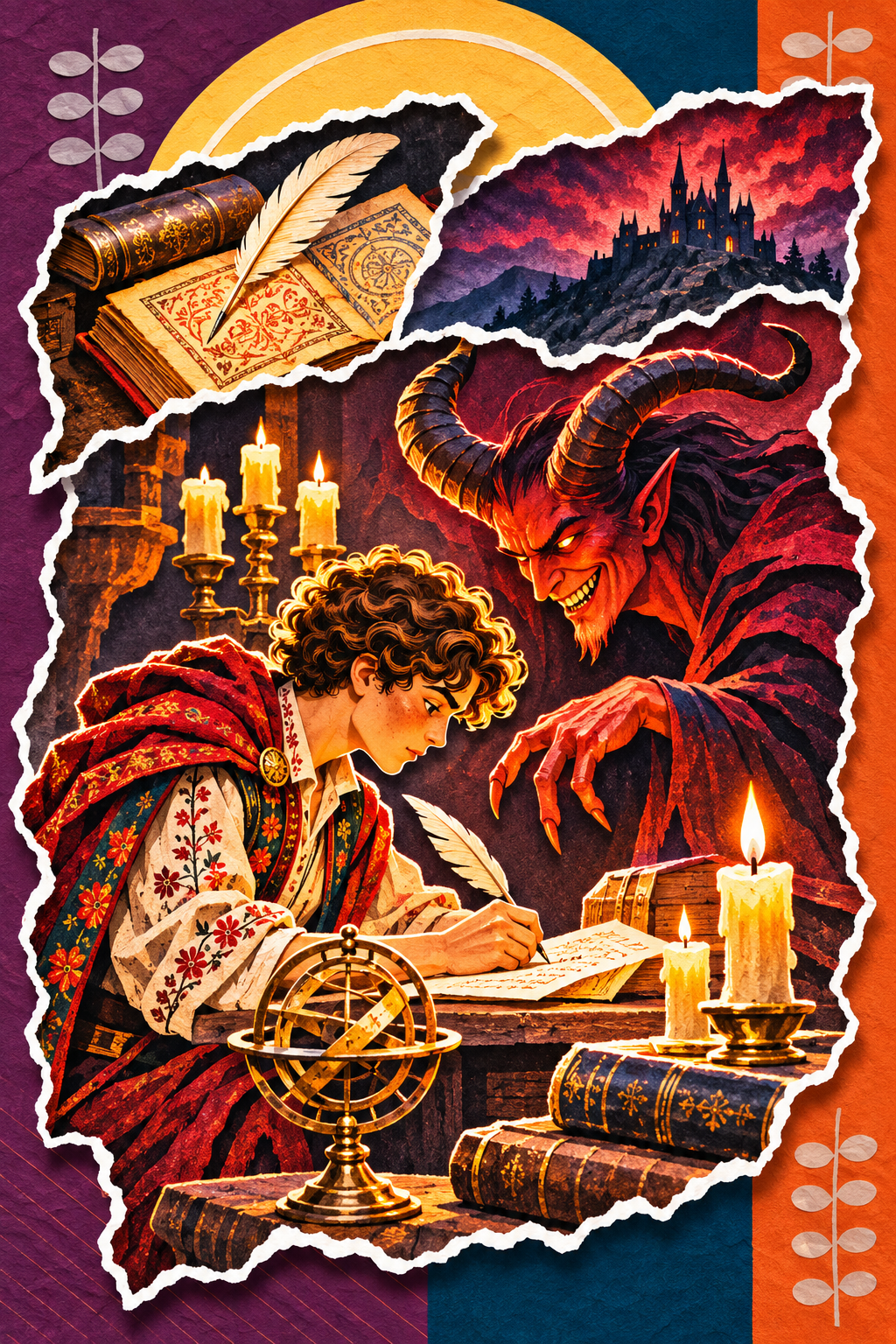
In an imagined Kraków of the sixteenth century, a scholar named Twardowski grew weary of the limits of ordinary knowledge. He studied manuscripts, stars and the secrets of metals, yet every answer seemed to open another question. He wanted wisdom no teacher could offer and powers no human being should command.
One night, in a candlelit chamber, a stranger appeared beside his desk. The visitor promised him extraordinary learning and the ability to perform wonders. The price was written plainly: one day the Devil would claim his soul. Twardowski read the parchment carefully and smiled. He would sign, he said, but only on one condition: the Devil could collect him in Rome.
The magician had no intention of travelling to Italy. Certain that he had found a loophole, he set his name beneath the agreement. The candle flames bent in the sudden wind, and the bargain was made.
Explore this scene as metal art →The Master of Magic
A city marvels at its sorcerer

Knowledge came to Twardowski with dizzying speed. In his workshop, books opened without hands, strange lights shimmered over glass vessels, and formulas that had once puzzled him now seemed almost effortless. Rumours crossed Kraków: a nobleman had learned to command forces beyond nature.
Some people came to ask for marvels. Others sought his counsel, believing that no question was beyond his reach. The magician enjoyed his growing reputation. Each new display of power seemed to confirm his cleverness, and every passing day made the promised price feel more distant.
Yet among his instruments and illuminated pages, the signed agreement remained. He kept it out of sight and rarely spoke of it. The Devil had given him magic, but time had not cancelled the contract.
Explore this scene as metal art →The Royal Summoning
The king and the enchanted mirror
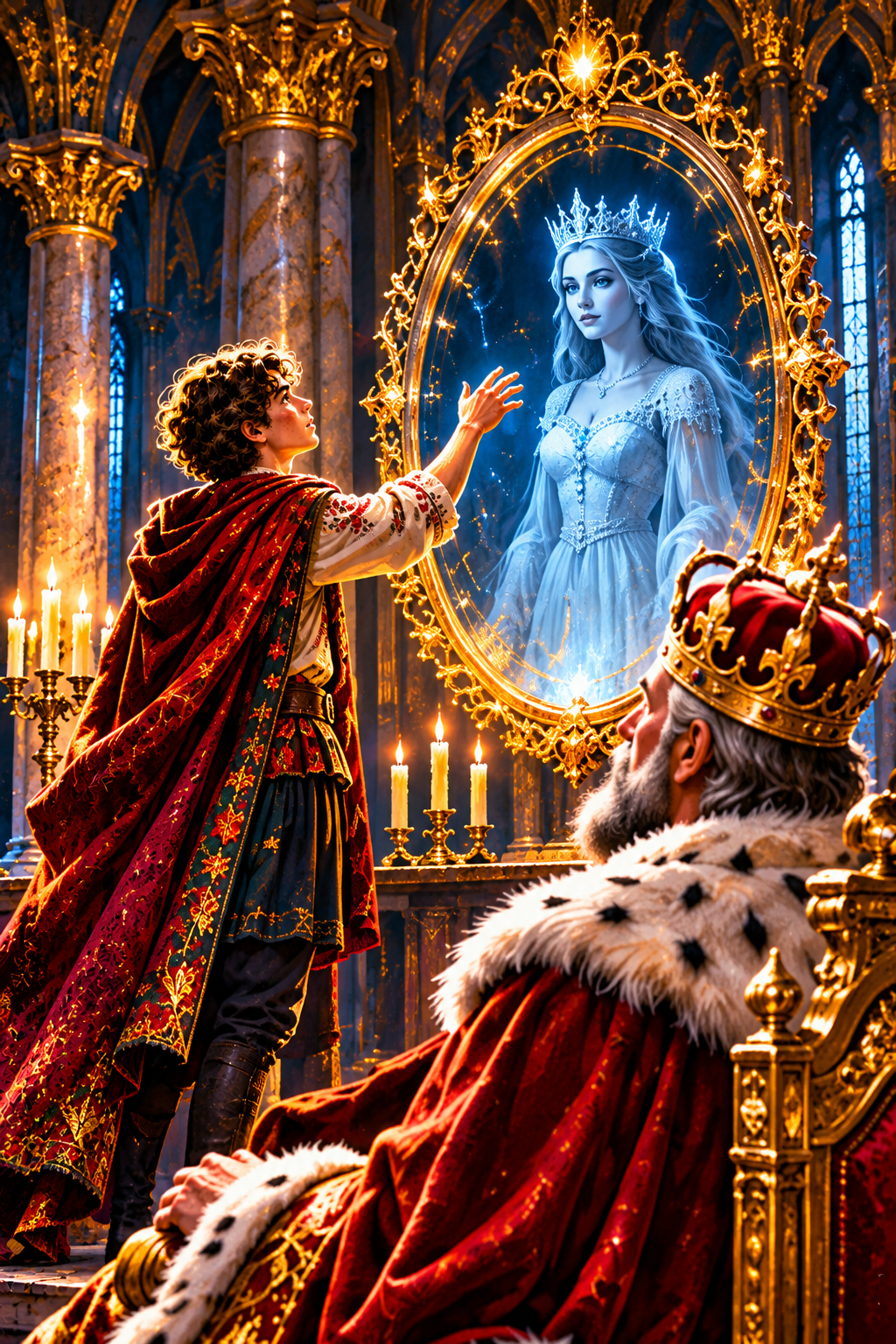
At the royal court, King Sigismund II Augustus mourned Barbara Radziwiłłówna, his beloved wife. Stories of Twardowski’s astonishing powers eventually reached the king. Could the magician show him the face he longed to see again? The request tested a boundary between grief, hope and the supernatural.
In a richly appointed chamber, Twardowski prepared an extraordinary mirror. The courtiers fell silent. A pale radiance appeared upon its surface, and within the glow emerged the likeness of Barbara. The king leaned forward, caught between wonder and sorrow. No one dared interrupt the moment.
Whether such a séance ever happened is uncertain; it belongs to the legend rather than established history. But the scene became one of the most enduring images associated with Pan Twardowski, joining royal memory to the mysteries of Renaissance magic.
Explore this scene as metal art →The Devil’s Return
A promise is never forgotten
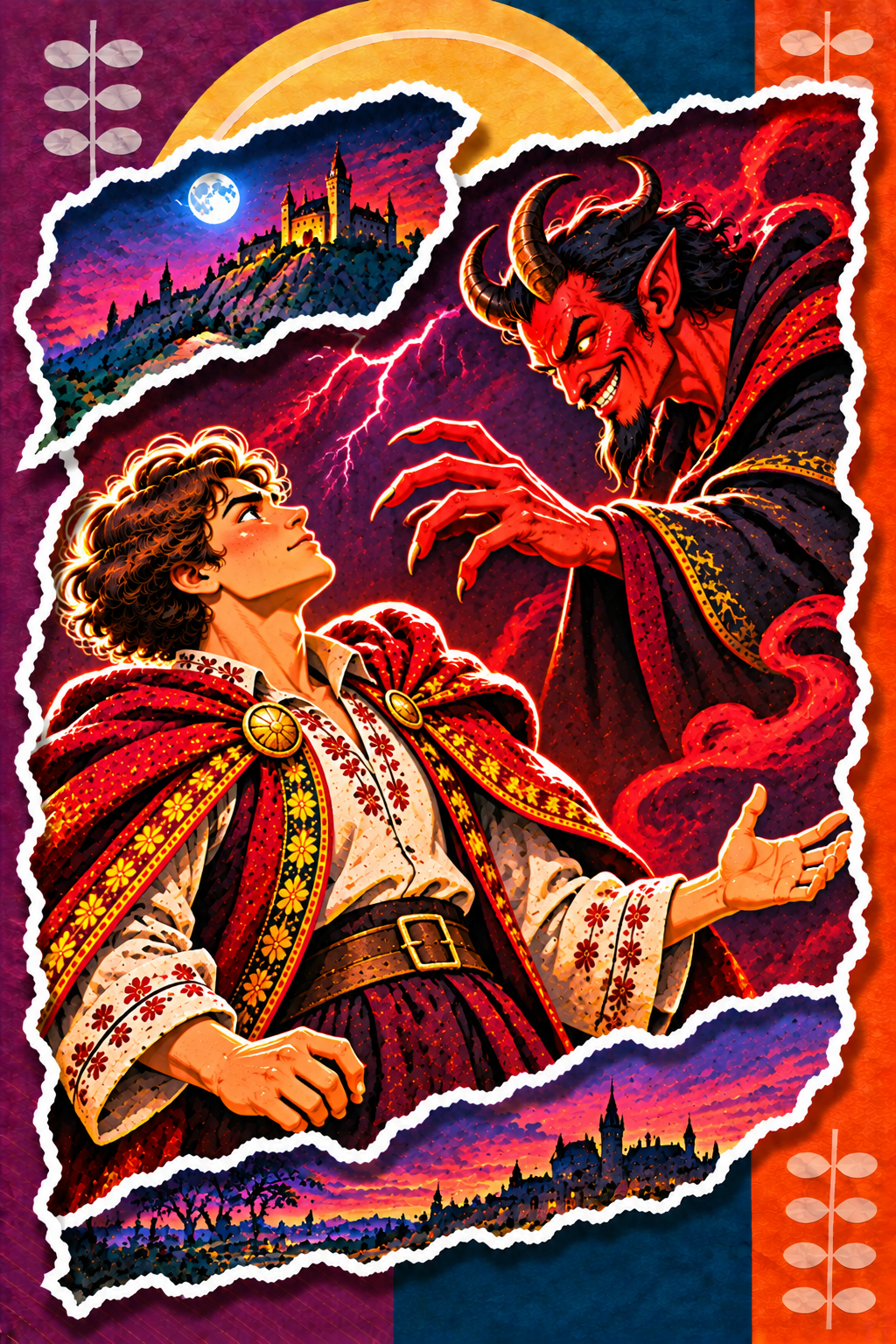
Years passed, and Twardowski grew accustomed to living as though the pact were merely an old story. He had avoided Rome, and he thought his caution had defeated the Devil. Then, one evening, a familiar voice spoke from the shadows.
The Devil had returned to remind him that the agreement still stood. All the sorcerer’s knowledge could not erase the words he had signed. Twardowski answered confidently that the condition had not been met: he was still in Poland, far from the city of Rome.
The Devil did not argue. Instead, he vanished with a smile. It was a smile that troubled the magician more than any threat, though Twardowski soon persuaded himself that his clever trick remained secure.
Explore this scene as metal art →The Roman Tavern
One name changes everything
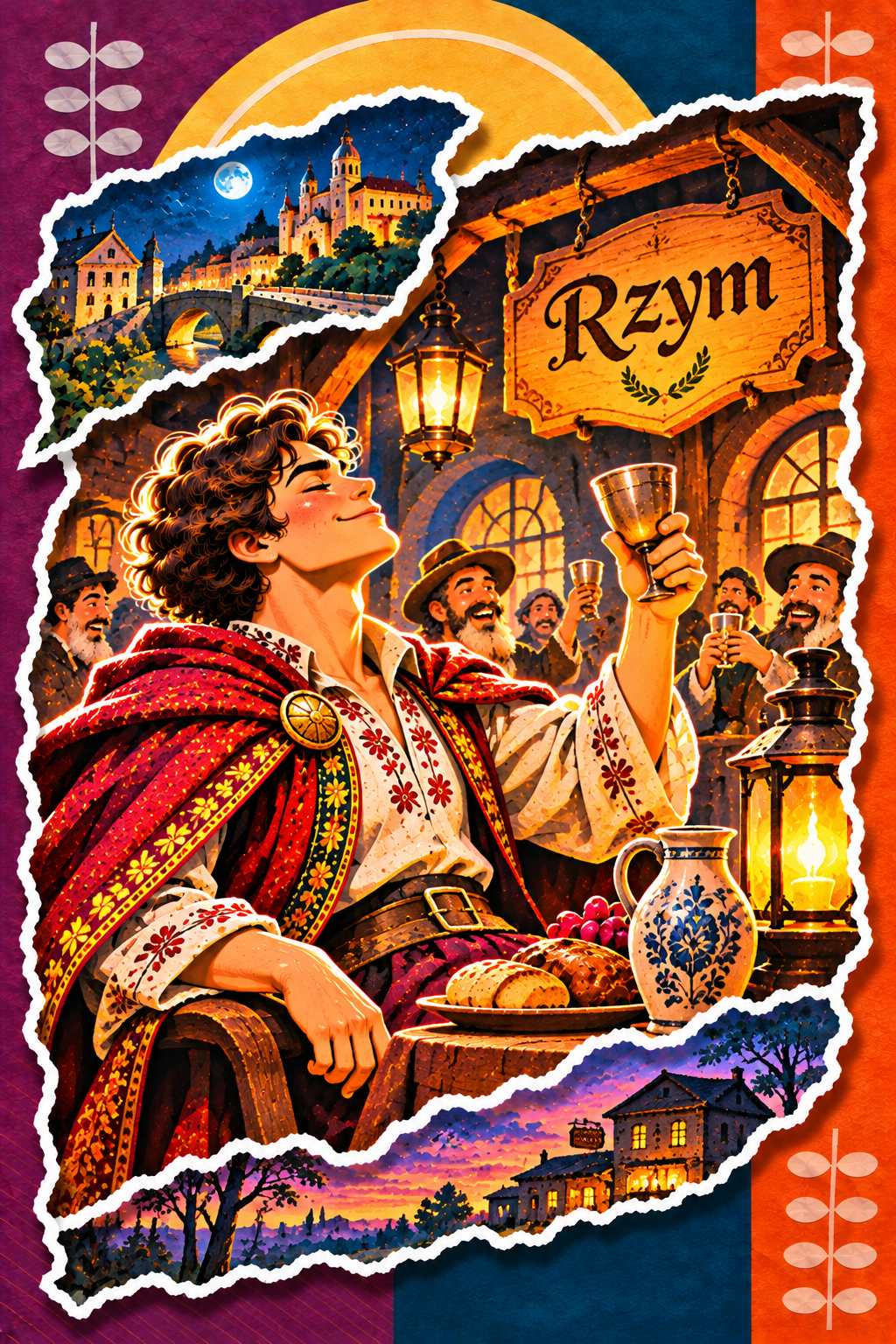
On a later journey, Twardowski stopped at a welcoming inn. Warm light spilled through its windows, and inside, travellers talked over food and drink. The scholar was pleased to rest. He had not crossed a border, boarded a ship or gone anywhere near Italy.
Above the entrance hung a painted sign: Rzym. In Polish, the word means Rome. Twardowski, intent on his supper, failed to consider what the name might mean for his contract. In the crowded room, the familiar sounds of laughter and clinking cups hid the danger waiting for him.
The tavern’s name gave the Devil the answer he had sought. The condition said only “in Rome”; it did not specify which Rome. The magician’s own trick had turned against him.
Explore this scene as metal art →The Devil’s Claim
The trap is sprung
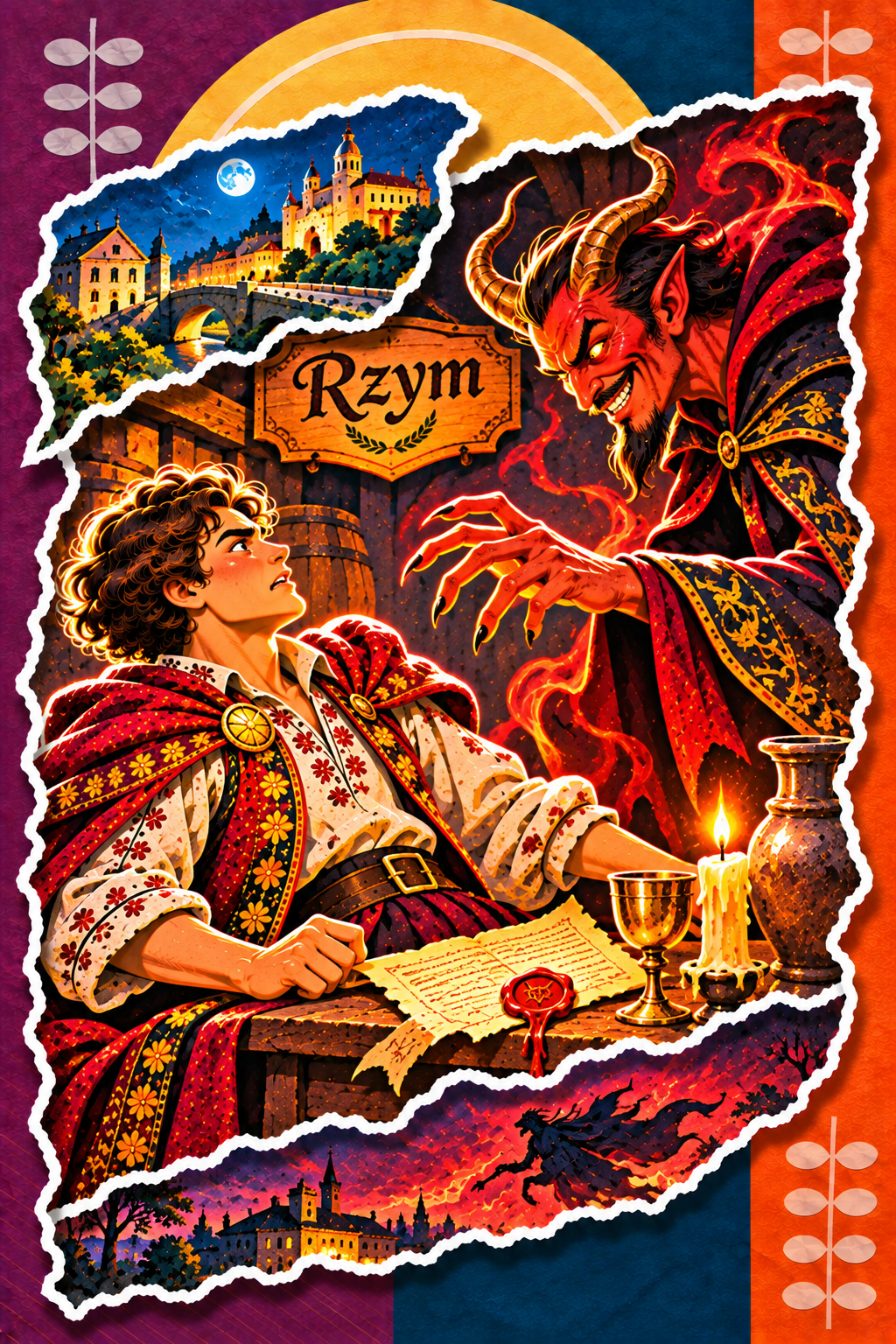
The doors seemed to close against the noise of the evening. From the shadows stepped the Devil, holding the old parchment. He pointed first to Twardowski’s signature and then to the sign over the tavern door. The magician’s heart sank.
He protested that this was not the eternal city on the Tiber, but the Devil had the words of the agreement on his side. Every clever argument Twardowski had used to protect himself suddenly seemed useless. The bargain he had treated as a game of language was now a demand he could not escape.
Around them the room grew strange and still. The Devil seized his prize, and Twardowski felt the ground slip away. The journey he had dreaded was beginning.
Explore this scene as metal art →The Flight to the Moon
A final appeal among the stars
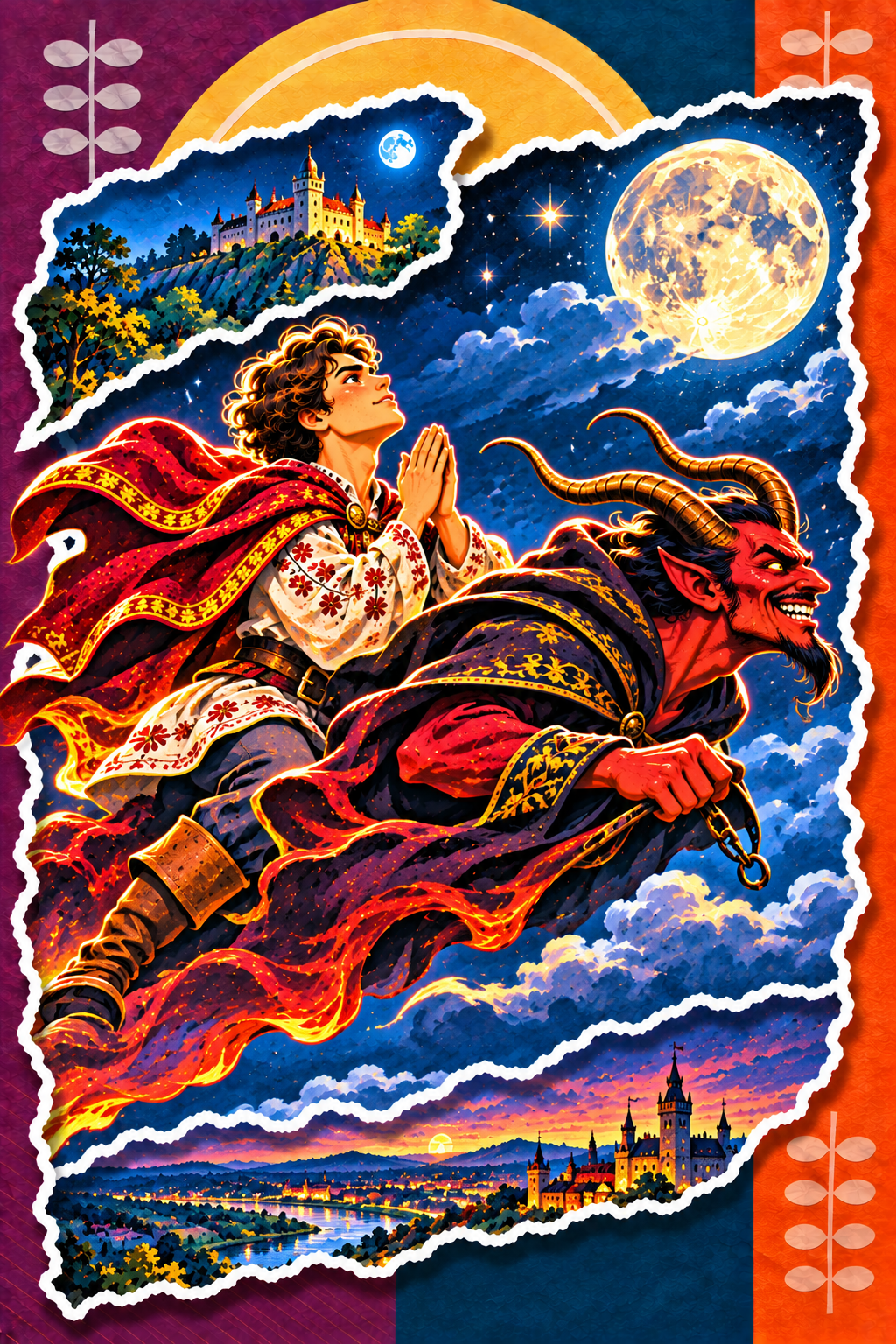
High above the sleeping countryside, the Devil carried Twardowski through the night. Below them lay the roofs of villages, the winding rivers and the far-off lights of the land he loved. The scholar could no longer pretend that his cunning had saved him.
Then he remembered the prayers he had known since childhood. In the traditional telling, he began to sing a hymn to the Virgin Mary. The Devil recoiled and lost his grip. For one breathless instant Twardowski was neither free on Earth nor taken into the infernal darkness.
He drifted towards the Moon, suspended in an impossible silence. The fields of Poland became a distant memory beneath the stars. His escape had spared him one fate, but it had opened the door to another.
Explore this scene as metal art →The Man on the Moon
The price of an unfinished escape
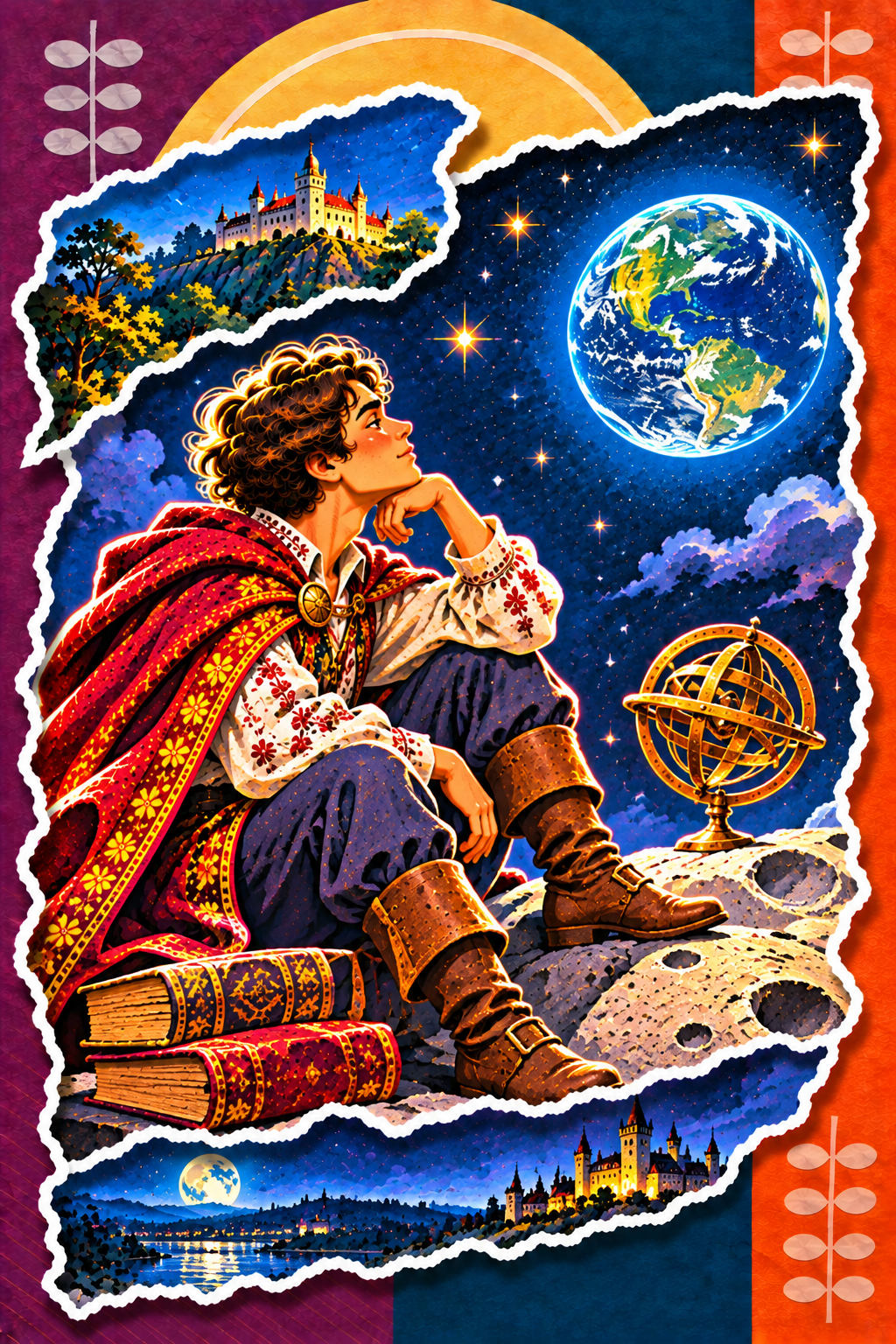
The sorcerer came to rest on the Moon. Far from Kraków and the familiar streets of home, he looked back at the small blue Earth. The knowledge he had gained remained with him, but neither his books nor his magic could take him back.
Some versions of the tale imagine a spider travelling between Earth and the Moon on a long thread, bringing Twardowski news from the world below. Other retellings leave him alone with his thoughts. The details change, but the image of the magician stranded in the heavens has become one of the legend’s most memorable endings.
So the story offers an uneasy victory: Twardowski eludes the Devil, yet cannot return to his ordinary life. The man who thought he could outwit every condition discovers that cleverness is not the same as wisdom.
Explore this scene as metal art →Why Is Pan Twardowski Called the Polish Faust?
Both figures are associated with a bargain with the Devil in exchange for extraordinary knowledge or power. That is the central reason Twardowski is compared with Faust, the celebrated figure of German legend and literature. Yet the Polish tale has its own tone: it often combines curiosity, bravado, folk humour and a trickster’s attempt to exploit contractual wording.
Pan Twardowski
A sorcerer rooted in Polish folklore, Renaissance Kraków and local oral tradition. The “Rome” tavern and Moon ending distinguish many retellings.
Faust
A German legend about a scholar’s pact with the Devil, later explored in major literary works. Its philosophical and dramatic treatment differs across versions.
It is more accurate to call Twardowski a Polish counterpart than to claim that one story is simply a copy of the other. The academic folklore dictionary discusses this difference, including the Polish tradition of the Devil being outsmarted.
Different Versions of the Legend
The Moon ending
In a widely known version, the Devil tricks Twardowski into a tavern called Rzym, then carries him through the sky. The magician prays, is released and remains on or near the Moon. Some stories add a servant transformed into a spider who brings him news of Earth. Culture.pl surveys these variations in detail.
Adam Mickiewicz’s Pani Twardowska
The famous 1822 comic ballad takes a very different approach. Twardowski devises a condition involving his wife, and the Devil chooses to run away rather than fulfil it. This witty version is not the same as the Moon ending, and it should not be treated as a scene that happens after Twardowski becomes stranded there. Read Culture.pl’s introduction to the ballad.
The royal mirror and later literature
Another enduring motif is Twardowski’s supposed summoning of Queen Barbara Radziwiłłówna for her grieving husband, Sigismund II Augustus. Later writers, painters and filmmakers repeatedly returned to this episode. Józef Ignacy Kraszewski’s nineteenth-century novel Mistrz Twardowski brought together several strands of the folklore, while twentieth-century films and artworks carried the legend into new forms.
Where Is the Pan Twardowski Legend Set?
Kraków
The city is traditionally associated with Twardowski’s scholarly life, magic and his connections to the royal court. Its historic streets and Wawel Castle provide a vivid setting, even though the story is not documented biography.
The tavern named Rzym
The pun on Rzym, Polish for Rome, is the key plot twist. Different places have been connected to this legendary inn; no single site can be confidently established as the actual scene of a supernatural event.
Węgrów
A mirror in a church in Węgrów is popularly linked to Twardowski. The attribution belongs to folklore and should not be presented as proof of magical events.
The Moon
The magician’s final home is a fantastical destination and a symbol of distance from ordinary human life. The lunar ending is among the most instantly recognisable features of the Polish story.
What Does the Pan Twardowski Legend Mean?
The story can be read as a warning against overconfidence: knowledge and power may be valuable, but neither makes a person immune to consequences. Twardowski understands the language of his bargain, or thinks he does, without understanding the intentions of the being who offered it.
There is also humour in the tale’s wordplay. The Devil turns a place name into a trap, and in another well-known version the magician uses a domestic challenge to frighten the Devil away. These twists are part of a wider storytelling tradition in which ordinary wit confronts apparently overwhelming supernatural forces.
Finally, the Moon gives the legend its bittersweet image. Twardowski escapes one terrible destination but ends up separated from his homeland. In the Eslaby illustration, the distance between the sorcerer and Earth becomes the emotional centre of the finale.
From folklore to illustrated metal art
Discover all eight scenes of Pan Twardowski at Eslaby, from the candlelit pact to the lunar conclusion. To explore other illustrated Polish folklore, visit Eslaby’s Offbeat folklore section, which also includes Warszawska Syrenka and other traditional stories.
Frequently Asked Questions
Who is Pan Twardowski?
He is a legendary Polish nobleman and sorcerer, usually associated with Renaissance Kraków, who bargains with the Devil for magical knowledge and power.
Why is Pan Twardowski called the Polish Faust?
Both figures make a pact with the Devil for extraordinary power or knowledge. Polish versions also emphasise clever loopholes, humour and local legends.
Why does Pan Twardowski end up on the Moon?
In a popular version, he is caught at an inn named Rzym (Rome), then prays while the Devil carries him away. He is released and stranded on or near the Moon.
What is the significance of the Rzym tavern?
It turns the condition in Twardowski’s contract against him: Rzym is Polish for Rome, so a Polish inn can satisfy the wording of the pact.
Did Pan Twardowski really exist?
His historicity is uncertain. There are early references and competing theories, but the supernatural episodes belong to folklore, not verified history.
Is Pani Twardowska the same story?
Not exactly. Adam Mickiewicz’s comic ballad uses the same legendary figures but offers a different resolution involving Twardowski’s wife.
Where can I find Pan Twardowski artwork?
Eslaby’s Pan Twardowski collection features eight distinct illustrations, each linked to an individual metal wall art product.
Sources and Further Reading
These external resources explore the documented literary history and distinguish the legend’s many variants:
- Nicolaus Copernicus University — Dictionary of the Polish Folk Tale: Pan Twardowski. Scholarly overview of oral traditions, literary sources and historical uncertainties (in Polish).
- Culture.pl — Pan Twardowski: The First Pole on the Moon. An accessible survey of early mentions and adaptations in Polish art and literature.
- Culture.pl — Pani Twardowska and Mickiewicz’s Humour. The famous alternative ending.
- Culture.pl — Eight Magical Depictions of Polish Legends. Historic illustrations of Twardowski and other folklore figures.
- Polish Educational Platform — The Faustian Myth. Educational comparison of Twardowski with the Faust motif (in Polish).
This is an original English retelling of traditional motifs. It is not a translation of a single copyrighted modern adaptation; variant details are identified separately above.
