ESLABY JOURNAL / METAL ART & DECOR
Metal Prints vs Paper Posters: What’s the Difference?
A practical, honest guide to materials, image quality, durability, costs and display—so you can choose the right wall art for your space.
A picture can look completely different depending on what it is printed on. The same city skyline might feel airy and understated on matte paper, but richer and more graphic on a glossy metal panel. If you are choosing wall art for your home—or a gift for someone else—the difference goes well beyond appearance.
In this guide, we compare sublimated aluminium metal prints and traditional paper posters across the factors that actually matter: finish, colour, handling, moisture, framing, price and long-term care. Neither option wins in every situation. The best one depends on the artwork, the room and your priorities.
Metal Prints vs Paper Posters: Quick Comparison
| Feature | Sublimated metal print | Paper poster |
|---|---|---|
| Material | Specially coated aluminium panel | Printed paper, from budget poster stock to archival fine-art paper |
| Appearance | Often glossy, smooth and high-contrast; finish varies | Matte, satin or glossy; many paper textures available |
| Rigidity | Holds its shape as a panel | Flexible; usually benefits from a frame or backing |
| Moisture | Generally more tolerant of incidental splashes when properly coated | More susceptible to warping, staining or water damage |
| Scratches | Coating may resist everyday marks, but can still scratch | Can scuff, crease or tear; glazing offers protection |
| Light exposure | Depends on coating, inks and conditions; not fade-proof | Depends strongly on paper, inks, glazing and conditions |
| Cost | Usually higher than a basic unframed poster | Often cheaper to start; quality framing adds cost |
| Best for | Bold decorative art, easy handling, rigid modern display | Low-cost décor, textured art, traditional framed presentation |
1. What Is a Metal Print—and How Is It Different from a Poster?
Metal prints
In dye-sublimated aluminium printing, an image is first printed using suitable sublimation inks and transfer paper, then heat and pressure move the colour into a receptive coating on the panel. The visible art sits in that specially prepared surface—not on bare, untreated metal.
Paper posters
Posters are printed onto paper using processes such as digital inkjet or commercial presses. The feel and longevity depend on the paper stock, ink technology and display conditions. Some are inexpensive decorative prints; others are carefully produced fine-art objects.
The manufacturer ChromaLuxe explains the dye-sublimation process and why a coated surface matters. At Eslaby, our compact decorative plaques use 20 × 30 cm coated aluminium, approximately 1 mm thick, with a glossy sublimated finish and cardboard backing. They are intended for indoor display, not as permanent outdoor signage.
2. Colour, Sharpness and Finish: Which Looks Better?
If you love vivid city lights, neon details and dramatic architectural contrast, a glossy metal surface can provide an eye-catching presentation. Its rigid, smooth finish makes clean lines and saturated visual designs feel particularly striking.
Paper gives you more choice in tactile and visual character. A matte art paper can reduce reflections and complement minimalist photography, vintage maps and softer illustrations. A textured fine-art sheet may suit watercolour-inspired imagery better than a slick glossy panel.
Neither material automatically produces sharper images. Original file resolution, print size, colour management, printer, ink and coating all influence the final result. A poorly prepared image will not become high resolution simply because it is printed on aluminium.

3. Durability: Water, Handling, Creases and Scratches
One practical reason to choose aluminium wall art is its rigidity. You can handle a small metal panel without the folding and creasing risks associated with unmounted paper. Its coated surface can also cope better with occasional moisture contact than an ordinary poster.
But it is worth being precise. Water-resistant does not mean suitable for immersion, and scratch-resistant does not mean scratch-proof. Sharp objects, abrasive cloths, aggressive cleaning products and impacts can still damage the surface or edges. Eslaby recommends using a soft microfibre cloth, slightly dampened with water if necessary, then drying gently.
Paper posters have different weaknesses: corners can bend, rolls can retain a curl, and exposed surfaces can crease or stain. A properly chosen frame and glazing can mitigate several of these risks, although the frame adds cost, weight and maintenance.
For a useful benchmark, ChromaLuxe describes the cleaning and resistance properties of its own coated panels. Those manufacturer-specific claims should not be assumed to apply identically to every aluminium blank, including other brands.
4. Do Metal Prints Last Longer Than Paper Posters?
The honest answer is: it depends on the materials and environment. There is no universal lifespan for either category.
High-quality pigment printing on carefully selected archival paper can be remarkably stable when stored or displayed correctly. Conversely, inexpensive prints of either kind may deteriorate faster. Testing results belong to particular combinations of ink, substrate and coating; they cannot automatically be transferred to another product.
The Northeast Document Conservation Center specifically stresses the importance of matched inks and papers. The Library of Congress also explains why light is a concern even for carefully framed paper materials.
For both decorative metal art and posters, the safest everyday advice is straightforward: avoid prolonged strong direct sunlight, excess heat, frequent temperature swings and unnecessary abrasion. We do not claim a specific laboratory-tested display lifespan for Eslaby plaques.
5. Framing, Weight and Interior Style
Metal: a clean contemporary statement
Rigid panels lend themselves to a modern, uncluttered look, especially for geometric architecture, striking skylines and graphic black-and-white designs. However, always check how a particular panel is supplied and mounted: not every metal print includes a hanging system, and some small decorative plaques need a separate compatible display solution.
Paper: flexibility and framing options
Paper can be displayed in an inexpensive poster frame, mounted with a mat, placed in a premium gallery frame or kept in a portfolio. Changing a poster is often simple, so paper works especially well for people who regularly refresh their décor.
For valuable photographic prints, good framing goes further than aesthetics. The Library of Congress framing guidelines discuss compatible materials, glazing and protection from environmental damage.

6. Which Is More Affordable?
A basic paper poster usually has the lower entry price, particularly in standard sizes. If you already own a frame, replacing the print may be very economical. But a quality frame, mounting materials and protective glazing can make a framed paper presentation considerably more expensive than the loose poster alone.
Sublimated aluminium usually costs more to produce than an ordinary paper sheet because it requires a specially coated panel and a heat-transfer workflow. For a fair comparison, look at the total display cost: artwork, frame or mounting hardware, shipping, and whether you expect to replace it.
At Eslaby, the product pages show current pricing and specifications for each plaque; check individual listings rather than relying on a price quoted in an older blog post.
7. Metal Print or Paper Poster: Which One Should You Choose?
Choose metal if…
- You like a sleek, rigid, contemporary object.
- You prefer vivid graphic artwork and strong contrast.
- You want something less prone to creasing than paper.
- You value easy, gentle surface dusting.
- A specific city or building is the focus of your décor.
Choose paper if…
- Your budget is tight.
- You enjoy matte surfaces, paper textures or traditional frames.
- You regularly swap the art on your walls.
- You want very large prints at an accessible starting cost.
- You plan to assemble a carefully framed archival display.
For students and temporary spaces: paper may be the simpler, cheaper choice. For a compact decorative gift: a metal plaque can feel like a finished object. For a valuable photographic edition: assess the exact printing process and conservation information rather than buying solely by material.
8. What Do Real Sublimated Metal Prints Look Like? Eslaby Examples
At Eslaby, based in Slovakia, city-inspired artworks are developed with a focus on architecture, memory and atmosphere before being sublimated onto coated aluminium. These examples illustrate how different styles can work on the same material.
Brutalist geometry in monochrome, made for architecture enthusiasts and understated interiors.
View the metal print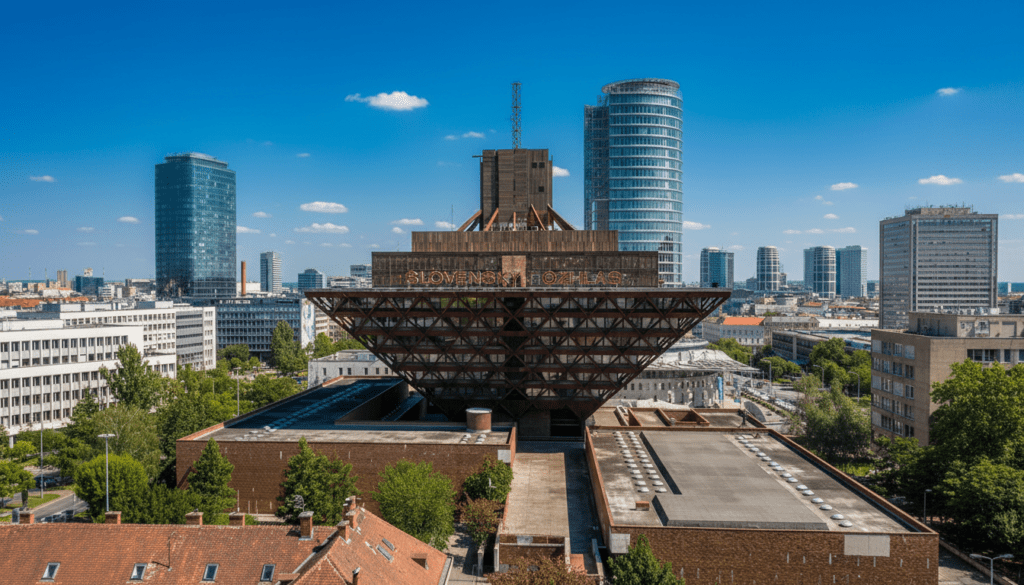
An unforgettable inverted pyramid, reinterpreted as futuristic urban art.
Explore the artwork
A historic Polish landmark rendered in a graphic noir style.
See the Krakow printMedieval detail, electric colour and a dramatic cyberpunk atmosphere.
View Prague artworkExplore more artwork inspired by Slovakia, Poland and other European destinations in our city-inspired metal art collections.
9. How to Look After Metal Prints and Paper Posters
For a coated metal print
- Dust gently with a clean microfibre cloth.
- If the manufacturer permits, use a slightly damp cloth and dry the surface promptly.
- Avoid abrasive brushes, solvents and harsh cleaners unless explicitly approved for that exact coating.
- Keep it away from sharp impacts, persistent moisture and strong direct sun.
For a paper poster
- Handle with clean, dry hands and support the sheet when moving it.
- Use appropriate framing or protective storage for valuable prints.
- Keep paper away from splashes, high humidity and direct sunlight.
- Avoid adhesive tape applied directly to collectible or archival artwork.
For additional practical guidance, see the Library of Congress recommendations on handling and storing photographic prints.
Frequently Asked Questions
Are metal prints better than posters?
Not universally. Metal is attractive for rigid, modern display and better resistance to casual handling. Paper offers more textures, framing choices and low-cost options. Quality depends on the exact materials and printing process.
Do metal prints scratch?
Yes, they can. Some coated products resist light everyday marks, but their surfaces can still be scratched by sharp objects, abrasive materials or rough treatment.
Can metal prints get wet?
Some specially coated metal prints tolerate brief splashes better than paper. That does not mean every product is waterproof, suitable for immersion or approved for permanent outdoor display.
Do paper posters fade faster than metal prints?
There is no universal rule. The ink, paper or coating, exposure to light and environmental conditions all influence longevity. Premium archival paper and ink combinations can perform very well.
Do I need to frame a metal print?
Not always. Many metal prints are displayed without glazing, but you must check whether the specific product includes hanging hardware. Paper usually benefits from framing or mounting for protection and appearance.
What is dye sublimation on aluminium?
It is a heat-transfer technique that uses specialised inks and a receptive coating on aluminium. The image is transferred into that coating under heat and pressure.
Is a metal plaque a good gift?
It can be, especially when the artwork depicts someone’s hometown, favourite building or memorable travel destination. Check dimensions, finish and the recipient’s decorating style before choosing.
Sources and Further Reading
For readers who would like to go beyond the buying guide:
- ChromaLuxe — Dye sublimation, coated metal prints and manufacturer care guidance (claims apply to its own product line).
- Northeast Document Conservation Center — Creating Long-Lasting Inkjet Prints.
- Library of Congress — Paper preservation FAQ.
- Library of Congress — Preservation Guidelines for Matting and Framing.
- Library of Congress — Care, Handling and Storage of Photographs.
