ESLABY JOURNAL / METAL ART & DECOR
What Is Sublimation Printing on Aluminium?
How heat, dye and a specially coated metal surface turn digital artwork into colourful wall art — and what you should know before buying.
A bright city skyline on a slim sheet of aluminium might look like a photograph printed directly onto metal. In many cases, however, the picture arrived there by a more interesting route: it was first printed on paper, then transferred into a coating using heat and pressure.
This is dye-sublimation printing on aluminium, a technique used for decorative metal prints, photographs and personalised products. It can produce detailed images with a smooth finish, but it also depends on the right inks, a receptive coating and careful heat-press settings. Here is how the process actually works, what it does well, and where its limits lie.
What Is Dye-Sublimation Printing on Aluminium?
Aluminium sublimation is a heat-transfer printing process. A design is printed onto specialist transfer paper with dye-sublimation inks. The printed side is positioned against an aluminium panel that has a compatible polymer coating. Under controlled heat and pressure, the dyes move into that coating and form the image.
The distinction matters: the image is not simply printed onto bare aluminium. Untreated metal will not behave like a sublimation-ready panel. The coating is the part that accepts the colour. Metal provides the rigid, lightweight support underneath.
For a manufacturer’s explanation, see ChromaLuxe’s dye-sublimation FAQ. Its guidance is useful for understanding the technology, although performance claims for ChromaLuxe panels apply to its own products and should not automatically be applied to all aluminium blanks.
How Does Aluminium Sublimation Work? Six Main Steps
Prepare the artwork
The design is sized for the panel and checked for resolution, composition and colour. The finished file should suit the intended print dimensions.
Print the transfer
A compatible printer uses sublimation dye inks to print on transfer paper. The artwork is often mirrored so it appears correctly after transfer.
Prepare the aluminium
The protective film is removed from the sublimation-ready panel, and the coated face is checked for dust, fingerprints or other contamination.
Align and secure
The printed transfer is placed against the coated surface and held in position using heat-resistant tape or another suitable method.
Apply heat and pressure
The heat press activates the dye transfer. Time, temperature and pressure depend on the blank, coating, press and manufacturer’s instructions.
Remove, cool and inspect
The hot panel is handled safely, the paper is removed as directed, and the result is checked for sharpness, coverage and finish.
You can see a technical workflow in ChromaLuxe’s small-format aluminium instructions. Those instructions specify settings for particular ChromaLuxe panels; they are not universal settings for every sublimation blank.
Why Can’t You Sublimate onto Ordinary Aluminium?
Metal is not naturally receptive to sublimation dyes. The image needs a suitable polymer-based receptive layer. Without it, the process may produce little or no usable transfer, poor adhesion or an unstable result.
This is why suppliers distinguish between ordinary metal sheets and sublimation-ready coated aluminium panels. Different coatings, finishes and manufacturers can produce different results. A white-coated panel may show colour differently from a brushed-metal surface, where the metallic appearance can influence lighter areas of an image.
When choosing a metal print, asking about the finish — glossy, matte, white-base or brushed — is often more useful than asking only whether the substrate is aluminium.
What Equipment Is Used for Sublimation on Metal?
The printing side
- Artwork prepared at appropriate resolution
- Sublimation-compatible printer and dye inks
- Transfer paper suited to the ink and job
- Colour-management workflow
The transfer side
- Sublimation-coated aluminium panel
- Heat press with even temperature and pressure
- Heat-resistant tape and protective sheets
- Safe handling tools, including heat gloves
Not every household inkjet printer can create sublimation transfers: the ink system has to be compatible. Likewise, an ordinary metal sheet is not a substitute for a coated blank.
For makers researching setup, the Sawgrass heat-press reference is a useful starting point. The company explicitly advises testing and following the substrate manufacturer’s guidance rather than treating its table as a guaranteed recipe.
Why Do Sublimated Aluminium Prints Look So Vivid?
A smooth coated surface can render fine lines and saturated colour with an eye-catching finish. It is especially suited to artwork built around strong contrast: city lights, graphic shapes, architectural silhouettes and bold colour palettes.
That said, a glossy coating is not always preferable. It can reflect windows and lamps, especially on a wall opposite bright light. A matte finish may suit some photographic subjects better. Printed colour also depends on the original file, profiles, dyes and coating, so metal alone cannot rescue a low-resolution or poorly prepared image.

Are Sublimated Aluminium Prints Waterproof, Scratch-Proof or Fade-Proof?
No print is automatically indestructible. A coated aluminium panel is rigid and generally less prone to the creasing and moisture damage associated with an unprotected paper poster. But the coating can still scratch, the edges can be damaged, and colour can change with prolonged exposure to strong light or unsuitable conditions.
Manufacturers sometimes publish durability tests for specific combinations of panel, coating and ink. For example, ChromaLuxe describes resistance properties for its own coated panels. Those results do not establish the precise lifespan or performance of other products.
| Question | Practical answer |
|---|---|
| Can it handle splashes? | A suitable coated metal print may tolerate occasional splashes better than exposed paper. Dry it promptly; do not assume immersion is safe. |
| Will it scratch? | Yes, potentially. Avoid abrasive cleaning and contact with sharp objects. |
| Can sunlight fade it? | Yes. Direct sunlight and heat can affect colour over time; performance varies by material. |
| Is it suitable outdoors? | Only if the specific print system is rated for that environment. Ordinary decorative indoor plaques should not be assumed weatherproof. |
| Can it bend? | Thin aluminium panels are rigid relative to paper but can bend or dent if forced or struck. |
Sublimation vs UV Printing, Paper Posters and Canvas
Not all so-called metal prints use the same process. With UV printing, ink is deposited onto a surface and cured using ultraviolet light; with dye sublimation, dyes are heat-transferred into a suitable coating. These are different production systems, even if the finished objects look superficially similar.
A paper poster typically offers a lower starting price and more paper textures, while a canvas print provides a woven surface and a softer visual character. Sublimated aluminium is attractive when you want a compact, rigid decorative panel and a smooth surface.
For a fuller comparison of materials, read our related Eslaby Journal guide: our metal art collections.
What Can Go Wrong During Aluminium Sublimation?
Producing a clean transfer requires more than placing paper on a hot panel. Several quality issues have recognisable causes:
| Visible issue | Possible causes | What makers should check |
|---|---|---|
| Faded or weak colour | Incorrect settings, mismatched materials or colour management | Ink, profile, coating and supplier settings |
| Blurry or doubled outlines | Movement of transfer paper during pressing | Alignment and secure, heat-safe positioning |
| Specks or blank spots | Dust, fingerprints or surface contamination | Panel preparation and protective materials |
| Uneven transfer | Inconsistent temperature or pressure | Press calibration and panel placement |
| Unexpected colour shift | Profiles, paper, coating or image settings | Test prints and end-to-end colour workflow |
These are diagnostic possibilities, not a substitute for your equipment and substrate supplier’s instructions. Follow safety guidance: freshly pressed metal is extremely hot.
How Should You Clean and Display a Sublimated Metal Print?
- Use a soft cloth: gently remove dust with clean microfibre; use a little water only if needed and dry promptly.
- Avoid abrasives: scouring pads and strong solvents can damage the finish.
- Choose the location: avoid persistent condensation, harsh heat and prolonged direct sunshine unless the product is specifically rated for them.
- Handle by the edges: this reduces fingerprints on glossy surfaces.
- Mount carefully: use a display method appropriate to the item’s weight, backing and wall surface.
Every print technology comes with material-specific care instructions. Follow those supplied with your finished product whenever available.
How We Use Sublimation at Eslaby
At Eslaby, we turn architectural landmarks and city-inspired illustrations into physical wall art in Slovakia. Our decorative plaques use 20 × 30 cm, 1 mm coated aluminium with a glossy sublimated surface and cardboard backing.
The artwork is inspired by the character of European cities — from Brutalist landmarks in Bratislava to historic architecture in Krakow and Prague. It is designed as expressive visual art, not necessarily as an exact documentary photograph of the place.
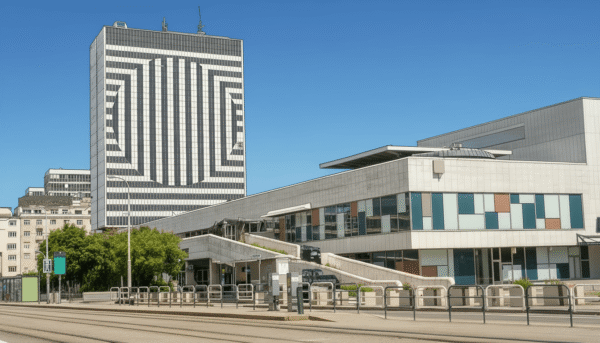
Bratislava’s Brutalist geometry in stark black and white.
View metal artwork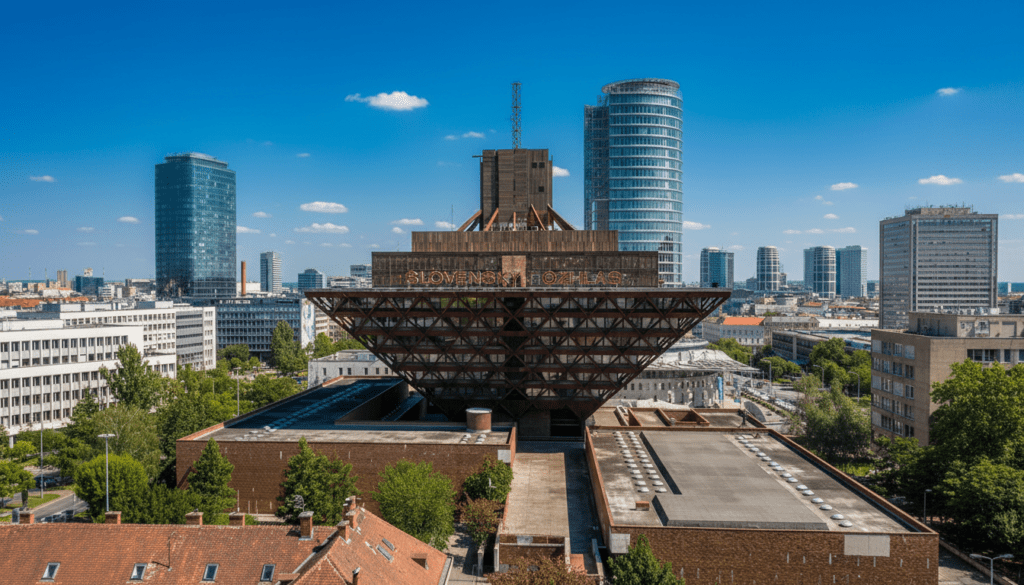
An unmistakable inverted pyramid reinterpreted in futuristic style.
View metal artwork
A landmark of Polish history interpreted through high-contrast city art.
View metal artworkHistoric details brought to life with a vivid contemporary palette.
View metal artworkExplore more locations in our Sublimated City Spots collections, or learn about the creative approach behind our pieces on Our Story.
Frequently Asked Questions
Is sublimation printing done directly onto bare aluminium?
No. It requires a compatible coating on the aluminium that receives the dyes during the heat-transfer process.
Is dye sublimation the same as laser engraving?
No. Sublimation transfers coloured dyes into a coating. Laser engraving changes or marks the material’s surface using a laser, producing a different appearance and effect.
What temperature is needed to sublimate aluminium?
There is no single setting for every panel. Time, temperature and pressure depend on the coating, panel size, equipment and supplier. Use the exact blank manufacturer’s instructions and test accordingly.
Can any home printer print sublimation transfers?
No. You need a printing system compatible with sublimation inks and suitable transfer paper.
Is sublimated aluminium better than a paper poster?
It depends on what you value. Metal offers a rigid, smooth decorative surface; paper can provide lower costs and a wider choice of textures and framing styles.
How long does an aluminium sublimation print last?
There is no universal lifespan. It depends on the dyes, coating, sunlight, humidity, handling and care. Specific laboratory claims should only be applied to the product systems tested.
Are Eslaby metal plaques suitable for outdoor use?
Eslaby’s standard decorative plaques are designed for indoor display. Do not assume they are suitable for prolonged weather exposure or immersion.
Sources & Further Reading
Technical references and background reading used to prepare this guide:
- ChromaLuxe — Dye-Sublimation FAQs (coated metal printing process and manufacturer-specific material properties)
- ChromaLuxe — Small-Format Aluminium Panel Instructions (example production workflow)
- Sawgrass — Sublimation Heat-Press Settings (starting points and the importance of testing)
- Eslaby — Our Story (how our city-inspired metal artworks are developed)
From Digital Design to Metal Art
Discover what architecture, colour and sublimated aluminium can become when they meet in a small piece of city-inspired wall art.
Explore Eslaby City Collections